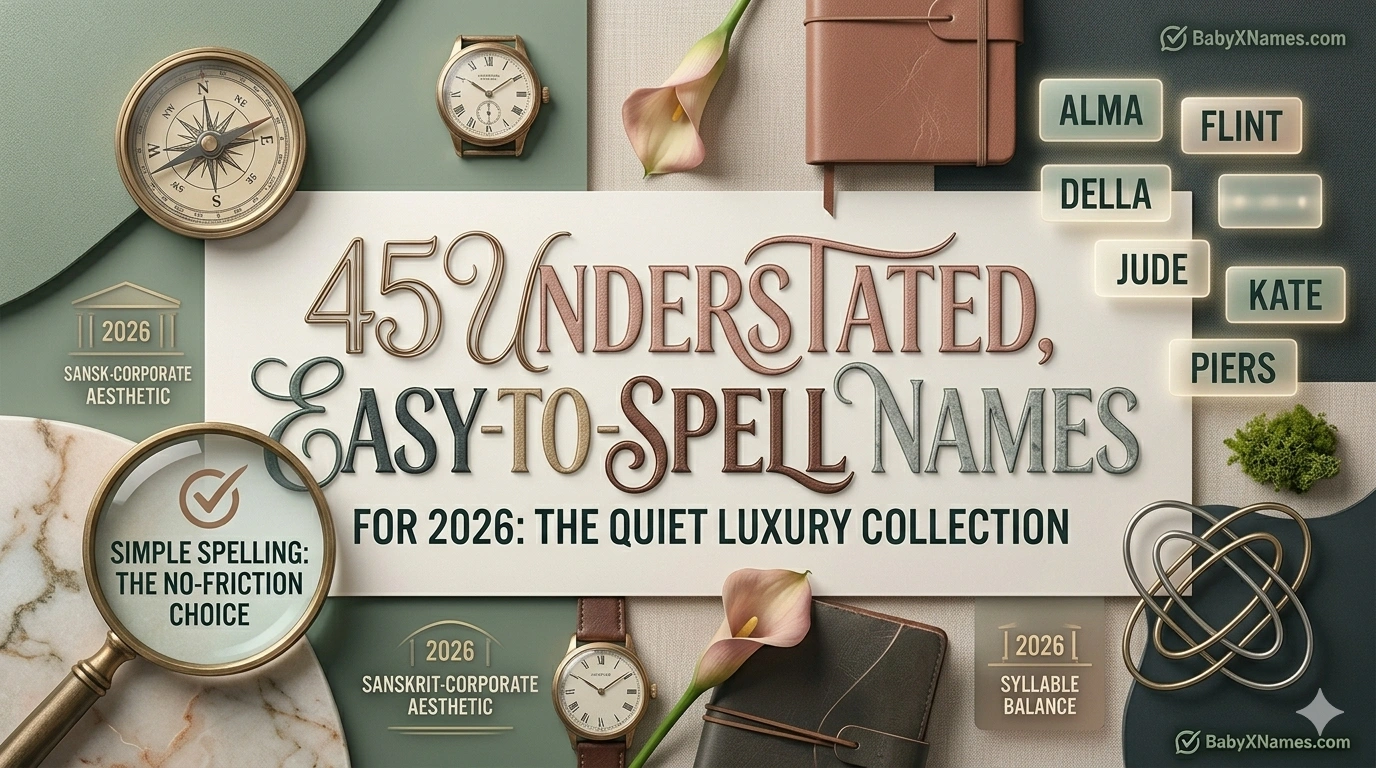
Selecting a baby name in 2026 has become an exercise in “Quiet Luxury.” Much like the fashion world’s move toward high-quality, logo-free staples, parents in Tier 1 countries are rejecting the loud, over-embellished names of the previous decade. The “naming dilemma” today is no longer about how to stand out through complexity, but how to stand out through refined simplicity. If you are seeking a moniker that carries weight without shouting, this curated list of 45 understated, easy-to-spell names for 2026 offers the perfect blueprint for a frictionless, high-status identity.
The shift toward understated names is a direct response to “digital fatigue.” In an age of endless notifications and complex algorithms, a name that is phonetically intuitive and visually clean acts as a breath of fresh air. For parents in the USA, Canada, UK, and Australia, choosing a name that is easy to spell ensures that their child’s path through digital registries, school rosters, and future professional networks remains entirely unobstructed.
Why Understated Names Are the New Gold Standard
An understated name is one that feels familiar but isn’t overused. It avoids the “creative spelling” traps of the 2010s—no extra ‘Y’s, no silent ‘H’s, and no hyphenated hurdles. These names possess “on-sight clarity,” meaning anyone who sees the name written down can pronounce it instantly, and anyone who hears it can spell it correctly on the first attempt.
In 2026, we are seeing a “Heritage Revival.” Parents are looking for names that have historical roots but have been “dusted off” to feel modern and sleek. These are names that suggest a high-status background without the pretension of a triple-barreled surname.
The 2026 Understated Girls’ Collection (25 Names)
These names prioritize soft vowels and strong consonant endings, ensuring they are easy to spell while remaining distinct.
- 1. Alma
- Origin: Latin/Spanish.
- Meaning: Soul or nourishing.
- Why it’s trending in 2026: It perfectly captures the “Vintage Minimalist” aesthetic that is dominating urban centers like London and New York.
- 2. Blair
- Origin: Scottish.
- Meaning: Field or battlefield.
- Why it’s trending in 2026: It has a sharp, preppy energy that feels executive and modern.
- 3. Clara
- Origin: Latin.
- Meaning: Bright or clear.
- Why it’s trending in 2026: As parents move away from the clunky Clarence, Clara remains the gold standard for understated elegance.
- 4. Della
- Origin: German.
- Meaning: Noble.
- Why it’s trending in 2026: It offers a rarer alternative to Bella or Stella with zero spelling ambiguity.
- 5. Edith
- Origin: Old English.
- Meaning: Prosperous in war.
- Why it’s trending in 2026: The “Grandmillennial” trend has matured; Edith (or Edie) feels grounded and sophisticated.
- 6. Flora
- Origin: Latin.
- Meaning: Flower.
- Why it’s trending in 2026: Nature names are becoming more sculptural and less “flowery.”
- 7. Greer
- Origin: Scottish.
- Meaning: Watchful or vigilant.
- Why it’s trending in 2026: It is a “one-way” spelling name that exudes Hollywood Golden Age glamour.
- 8. Hazel
- Origin: English.
- Meaning: The hazelnut tree.
- Why it’s trending in 2026: A classic that has regained its status as a top-tier nature name.
- 9. Iris
- Origin: Greek.
- Meaning: Rainbow.
- Why it’s trending in 2026: Short, punchy, and phonetically perfect for digital handles.
- 10. June
- Origin: Latin.
- Meaning: Dedicated to Juno.
- Why it’s trending in 2026: Seasonal names are shifting toward one-syllable simplicity.
- 11. Kate (Greek – “Pure”)
- 12. Lyra (Greek – “Lyre/Harp”)
- 13. Mara (Hebrew – “Strength”)
- 14. Nora (Latin – “Honor”)
- 15. Opal (Sanskrit – “Gemstone”)
- 16. Pearl (Latin – “Precious”)
- 17. Quinn (Irish – “Wise”)
- 18. Rose (Latin – “Flower”)
- 19. Selah (Hebrew – “To pause and reflect”)
- 20. Tess (Greek – “Harvester”)
- 21. Vera (Latin – “Faith”)
- 22. Willa (German – “Resolute”)
- 23. Xanthe (Greek – “Golden”)
- 24. Yael (Hebrew – “Mountain goat”)
- 25. Zoya (Greek/Russian – “Life”)
The 2026 Understated Boys’ Collection (20 Names)
For boys, understated names rely on architectural strength—short, stable sounds that suggest leadership without aggression.
- 26. Arlo
- Origin: Old English.
- Meaning: Fortified hill.
- Why it’s trending in 2026: The ‘O’ ending for boys remains the decade’s most fashionable phonetic trait.
- 27. Bram
- Origin: Dutch.
- Meaning: Father of many.
- Why it’s trending in 2026: It is a sophisticated, literary alternative to Liam or Noah.
- 28. Cass
- Origin: Greek.
- Meaning: Vain or empty (historically), now associated with “Cassian.”
- Why it’s trending in 2026: Short “cool-guy” names are replacing longer traditional versions.
- 29. Dean
- Origin: English.
- Meaning: Valley or leader.
- Why it’s trending in 2026: It carries a mid-century modern “cool” that never goes out of style.
- 30. Ezra
- Origin: Hebrew.
- Meaning: Help.
- Why it’s trending in 2026: It hits the perfect balance of ancient history and modern accessibility.
- 31. Flint
- Origin: English.
- Meaning: A hard quartz rock.
- Why it’s trending in 2026: Part of the “Mineral Naming” boom where parents pick grounded, real-word nouns.
- 32. Grant
- Origin: Scottish/French.
- Meaning: Great or tall.
- Why it’s trending in 2026: One-syllable executive names are seen as highly prestigious.
- 33. Hugo
- Origin: German.
- Meaning: Mind or spirit.
- Why it’s trending in 2026: It sounds established and international.
- 34. Jude
- Origin: Hebrew.
- Meaning: Praised.
- Why it’s trending in 2026: It is effortlessly rhythmic and works with almost any last name.
- 35. Kit
- Origin: Greek.
- Meaning: Bearing Christ.
- Why it’s trending in 2026: A sharp, gender-neutral favorite that is gaining traction in the UK and Australia.
- 36. Lane (English – “Small path”)
- 37. Milo (German – “Merciful”)
- 38. Nash (English – “By the ash tree”)
- 39. Otis (German – “Wealthy”)
- 40. Piers (Greek – “Rock”)
- 41. Reed (English – “Red-haired”)
- 42. Seth (Hebrew – “Appointed”)
- 43. Tate (Norse – “Cheerful”)
- 44. Vance (English – “Marshland”)
- 45. Wells (English – “Spring”)
Pro-Tip: The “Syllable Balance” Rule
When choosing an understated name, look at your last name. If you have a long, multi-syllabic surname (e.g., Richardson), a one-syllable understated name like Grant or Blair creates a high-status rhythmic balance. Conversely, a short last name (e.g., Smith) benefits from a two-syllable understated gem like Arlo or Clara.
Naming Trend Prediction for 2026: The “Sanskrit-Corporate” Aesthetic
As global business hubs continue to blend, we are predicting the rise of names that have Sanskrit roots but fit seamlessly into Western phonetic patterns. Names like Veda, Rishi, and Zoya are the new frontier of “Understated Standouts.” These names are exceptionally easy to spell but provide a unique cultural depth that feels very relevant in a globalized 2026 economy.
Frequently Asked Questions (FAQ)
What makes a name “understated”?
An understated name is one that is recognizable and traditional but has not been overexposed in popular culture. It lacks “trendy” features like intentional misspellings or aggressive sounds, opting instead for classic phonetics.
Why is simple spelling important in 2026?
Simple spelling reduces “digital friction.” In a world where your child will constantly be entering their name into forms, apps, and registries, a phonetically intuitive name prevents a lifetime of administrative errors.
Are these names popular in the UK and Australia?
Yes. The Tier 1 naming market is highly synchronized. Names like Hugo, Kit, and Flora are currently high-status favorites in London, Melbourne, and Vancouver alike.
Can a rare name still be easy to spell?
Absolutely. Names like Bram or Gretta are rare (statistically below the Top 500) but follow standard Eng