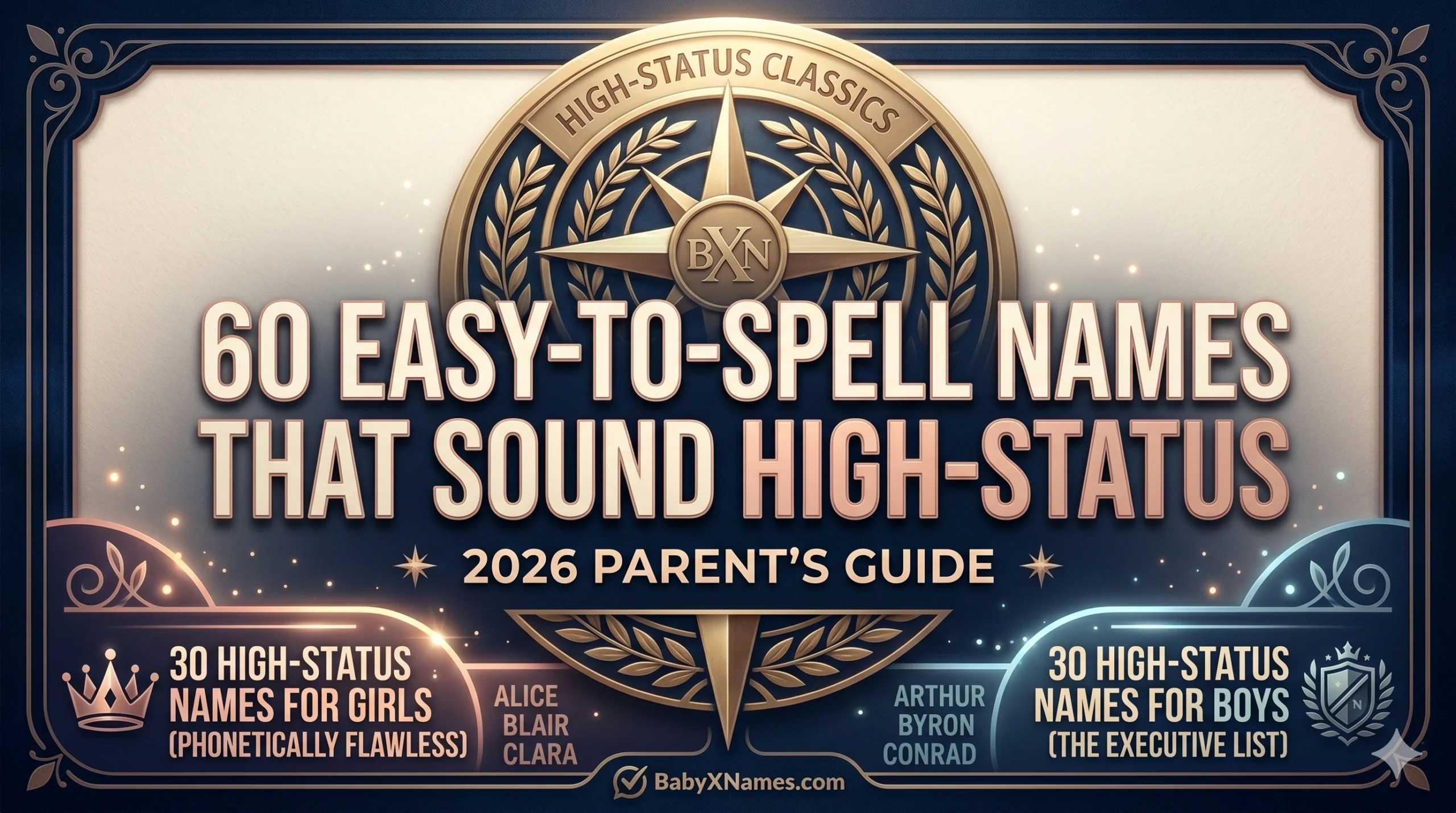
In the rapidly evolving social landscape of 2026, the “Old Money” aesthetic has moved beyond fashion and interior design into the realm of digital identity. Parents today are searching for a specific kind of linguistic prestige—names that carry an air of generational wealth and executive presence without the burden of complex spellings. If you are navigating the modern naming dilemma, you likely want a moniker that sounds like it belongs on a mahogany desk but is as simple to write as a four-letter word. Finding 60 easy-to-spell names that sound high-status is about capturing that elusive blend of simplicity and “quiet luxury.”
The trend toward “Clean Prestige” is a direct response to the over-embellished, “creative” naming era of the early 2020s. Today, high-status is signaled by restraint. A name that is phonetically intuitive suggests a family history that doesn’t need to shout to be noticed. Whether you are in the USA, UK, Canada, or Australia, these names provide a frictionless path through school rosters, digital applications, and future professional networks.
The Anatomy of a High-Status, Easy-to-Spell Name
What exactly makes a name sound “high-status”? It typically involves strong consonant anchors and historical roots in Greek, Latin, or Old English. These names avoid “filler” letters and redundant vowels. For instance, while Maximilian is undeniably prestigious, it is prone to spelling errors. Conversely, a name like Max or Miles retains that same architectural strength while being impossible to misspell.
In 2026, the “Global Elite” aesthetic favors names that work across Tier 1 borders. These are names that feel as at home in a London boarding school as they do in a Sydney tech hub or a Toronto law firm.
30 High-Status Names for Girls (Phonetically Flawless)
These names exude elegance and authority while following standard English phonetic rules.
- 1. Alice
- Origin: Old French/German.
- Meaning: Noble.
- Why it’s trending in 2026: It is the quintessential “Clean Girl” name—timeless, noble, and only five letters.
- 2. Blair
- Origin: Scottish.
- Meaning: Field or battlefield.
- Why it’s trending in 2026: It carries a preppy, “Upper East Side” vibe that remains sharp and modern.
- 3. Clara
- Origin: Latin.
- Meaning: Bright and clear.
- Why it’s trending in 2026: Modern parents are ditching the clunky Clarence for this sleek, high-clarity alternative.
- 4. Diana
- Origin: Latin.
- Meaning: Divine.
- Why it’s trending in 2026: Royal associations give this name an immediate status boost.
- 5. Edith
- Origin: Old English.
- Meaning: Riches or blessed.
- Why it’s trending in 2026: Part of the “Vintage Revival” where names associated with inheritance are making a comeback.
- 6. Flora
- Origin: Latin.
- Meaning: Flower.
- Why it’s trending in 2026: Nature names are getting a “high-society” makeover, moving from hippie to heritage.
- 7. Grace
- Origin: Latin.
- Meaning: Virtue or favor.
- Why it’s trending in 2026: Simplicity is the ultimate sophistication. It never goes out of style.
- 8. Helen
- Origin: Greek.
- Meaning: Torch or shining light.
- Why it’s trending in 2026: It sounds established and intellectual.
- 9. Iris
- Origin: Greek.
- Meaning: Rainbow.
- Why it’s trending in 2026: Sharp, three-letter names are the gold standard for mobile-first digital identities.
- 10. Jane
- Origin: Hebrew.
- Meaning: God is gracious.
- Why it’s trending in 2026: The “Plain Jane” stigma has vanished; it is now seen as a minimalist power-move.
- 11. Kate (Greek – “Pure”)
- 12. Lara (Latin – “Famous”)
- 13. Maud (German – “Battle-mighty”)
- 14. Nora (Latin – “Honor”)
- 15. Opal (Sanskrit – “Gem”)
- 16. Pearl (Latin – “Precious”)
- 17. Rose (Latin – “Flower”)
- 18. Ruth (Hebrew – “Friend”)
- 19. Vera (Russian/Latin – “Faith/Truth”)
- 20. Willa (German – “Resolute protection”)
- 21. Anne (Hebrew – “Favor”)
- 22. Belle (French – “Beautiful”)
- 23. Celia (Latin – “Heavenly”)
- 24. Eve (Hebrew – “Life”)
- 25. Faye (French – “Loyalty/Fairy”)
- 26. Gwen (Welsh – “White/Blessed”)
- 27. Hope (English – “Virtue”)
- 28. June (Latin – “Young”)
- 29. May (Latin – “Goddess Maia”)
- 30. Tess (Greek – “Harvester”)
30 High-Status Names for Boys (The Executive List)
For boys, high-status names often rely on short, impactful sounds that suggest leadership.
- 31. Arthur
- Origin: Celtic.
- Meaning: Bear or noble.
- Why it’s trending in 2026: It bridges the gap between old-world royalty and modern “cottagecore” aesthetics.
- 32. Byron
- Origin: Old English.
- Meaning: At the byres or barn.
- Why it’s trending in 2026: It has a literary, sophisticated flair that sounds like “Old Money.”
- 33. Conrad
- Origin: German.
- Meaning: Brave counsel.
- Why it’s trending in 2026: It sounds like the name of a CEO or a founder.
- 34. Dean
- Origin: Greek/English.
- Meaning: Leader.
- Why it’s trending in 2026: It is mid-century modern, cool, and undeniably easy to spell.
- 35. Grant
- Origin: Scottish/French.
- Meaning: Great or tall.
- Why it’s trending in 2026: One-syllable names are peaking for their “no-nonsense” corporate appeal.
- 36. Hugo
- Origin: German.
- Meaning: Mind or spirit.
- Why it’s trending in 2026: It is a global “power name” that works in every Tier 1 country.
- 37. Jude
- Origin: Hebrew.
- Meaning: Praised.
- Why it’s trending in 2026: Effortlessly cool and emotionally resonant.
- 38. Mark
- Origin: Latin.
- Meaning: Dedicated to Mars (Warlike).
- Why it’s trending in 2026: Classic names are being reclaimed by parents tired of trendy inventions.
- 39. Otis
- Origin: German.
- Meaning: Wealthy.
- Why it’s trending in 2026: Literally means wealthy; it’s a playful but prestigious choice.
- 40. Piers
- Origin: Greek/French.
- Meaning: Rock.
- Why it’s trending in 2026: A classic British “High-Status” name that is easy for North Americans to spell.
- 41. Reid (English – “Red-haired”)
- 42. Seth (Hebrew – “Appointed”)
- 43. Troy (Greek – “Water/Soldier”)
- 44. Vance (English – “Marshland”)
- 45. Ward (English – “Guard”)
- 46. Zane (Hebrew – “God’s gift”)
- 47. Alec (Greek – “Defender”)
- 48. Bram (Dutch/Hebrew – “Father of many”)
- 49. Cole (English – “Victory of the people”)
- 50. Finn (Irish – “Fair”)
- 51. Guy (French – “Guide”)
- 52. Hugh (German – “Intellect”)
- 53. Ivan (Slavic/Hebrew – “God is gracious”)
- 54. Kent (English – “Edge/Coastal land”)
- 55. Luke (Greek – “Light”)
- 56. Miles (Latin – “Soldier”)
- 57. Paul (Latin – “Small/Humble”)
- 58. Ross (Scottish – “Headland”)
- 59. Saul (Hebrew – “Prayed for”)
- 60. Tate (Norse – “Cheerful”)
Pro-Tip: The “Loudroom” Test
When evaluating a high-status name, imagine it being called out at a busy airport or a crowded gala. If it sounds like a command or an invitation rather than a question, you’ve found a high-status winner. If the person at the desk has to ask “How do you spell that?”, the prestige is instantly diluted.
Naming Trend Prediction for 2026
We are currently seeing the rise of “The Monosyllabic Elite.” As our attention spans shorten and our digital interactions increase, names like Grant, Blair, Jane, and Reid are becoming the new symbols of status. These names are seen as “clutter-free.”
By late 2026, we expect a surge in “Surnames as First Names” that are strictly four to five letters long. This “Surname Simplicity” allows a child to sound like they belong to a legacy family without the pretension of a three-part hyphenated name.
Frequently Asked Questions (FAQ)
What defines a “High-Status” name?
A high-status name typically has historical longevity, royal or aristocratic associations, and a clean phonetic structure. It avoids “trendy” suffixes like -den or -lynn and instead relies on classical roots.
Why is spelling so important for status?
In high-level professional environments, clarity is efficiency. A name that is constantly misspelled creates “friction.” A frictionless name suggests that the child belongs in rooms where decisions are made quickly and accurately.


![Read more about the article Top 100+ Baby Names That Mean Warrior [2026]](https://babyxnames.com/wp-content/uploads/2025/08/Baby-Names-That-Mean-Warrior--300x200.jpg)