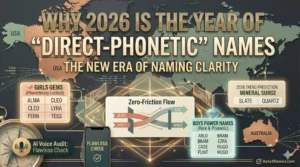
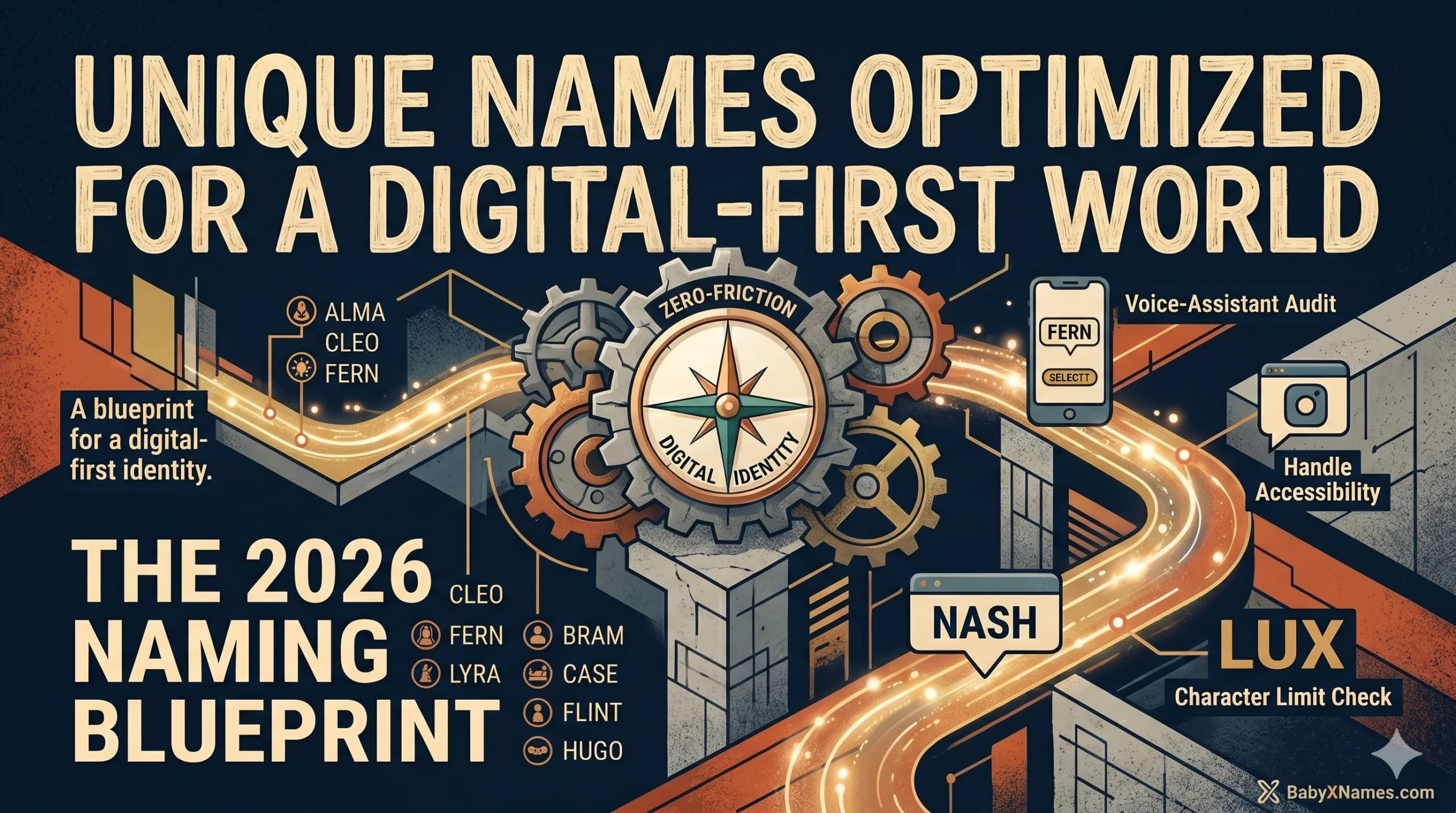
In the rapidly evolving social landscape of 2026, choosing a baby name has transformed from a sentimental tradition into a strategic branding decision. As our lives become inextricably linked with AI, automated databases, and global social networks, the “naming dilemma” has reached a fever pitch. Modern parents in Tier 1 countries like the USA, Canada, the UK, and Australia are no longer just looking for a name that sounds pretty; they are seeking unique names optimized for a digital-first world.
A digital-first name is one that possesses high “on-screen clarity.” It is phonetically intuitive, visually balanced, and—most importantly—resistant to the clerical errors that plague “creative” spellings. By prioritizing orthographic integrity and brevity, parents can ensure their child’s digital footprint is frictionless from day one. This guide explores how to navigate this new frontier of onomastics to find a moniker that is both rare and technologically future-proof.
The Concept of “Frictionless Onomastics”
Why is optimization so critical in 2026? Every time a name is entered into a system—be it a school portal, a flight booking, or a professional registry—there is a risk of data fragmentation. Names with complex, non-standard spellings create “digital friction,” requiring constant human intervention and correction.
By selecting unique names optimized for a digital-first world, you are gifting your child an identity that “flows” through systems. These names follow standard phonetic paths, meaning they are typed correctly by humans and parsed accurately by AI voice assistants. In a world of character limits and SEO-driven personal branding, a clean, short name is the ultimate high-status asset.
Top Digital-First Names for Girls: Rare & Intuitive
These selections prioritize soft vowels and stable consonant endings, ensuring they look as good in a URL as they do on a birth certificate.
- 1. Alma
- Origin: Latin.
- Meaning: Soul or nourishing.
- Why it’s trending in 2026: It is the quintessential “minimalist” choice. With only four letters and a globally recognized spelling, it is a powerhouse of digital clarity.
- 2. Cleo
- Origin: Greek.
- Meaning: Glory.
- Why it’s trending in 2026: Ending in a sharp ‘O’ is a major trend for girls this year. It stands out in social media headers for its punchy, energetic aesthetic.
- 3. Elara
- Origin: Greek Mythology.
- Meaning: Bright or shining.
- Why it’s trending in 2026: Celestial names are peaking, and Elara offers a softer, more intuitive sound than its clunkier counterparts like Cassiopeia.
- 4. Fern
- Origin: English.
- Meaning: Nature name (the green plant).
- Why it’s trending in 2026: Part of the “Sleek Nature” movement. It is a real-word noun, which guarantees that digital systems will never misspell it.
- 5. Lyra
- Origin: Greek.
- Meaning: Lyre or harp.
- Why it’s trending in 2026: It is the “perfect” digital name—short, melodic, and visually symmetrical.
High-Status Boy Names for a Digital Economy
For boys, digital optimization relies on architectural strength. These names suggest leadership and clarity, avoiding the “syllable clutter” of the past.
- 6. Arlo
- Origin: Old English.
- Meaning: Fortified hill.
- Why it’s trending in 2026: Friendly yet authoritative. Its brevity makes it exceptionally easy to turn into a clean email handle or digital signature.
- 7. Bram
- Origin: Dutch/Hebrew.
- Meaning: Father of many.
- Why it’s trending in 2026: Literary prestige meets one-syllable efficiency. It sounds established and executive.
- 8. Case
- Origin: English.
- Meaning: Box or chest.
- Why it’s trending in 2026: Surnames-as-first-names are massive, and Case is the most streamlined, error-proof version currently climbing the charts.
- 9. Flint
- Origin: English.
- Meaning: A hard quartz rock.
- Why it’s trending in 2026: Grounded nouns are king in 2026. A name that is also a physical object is inherently optimized for global recognition.
- 10. Hugo
- Origin: German/Spanish.
- Meaning: Mind or spirit.
- Why it’s trending in 2026: It is a global “power name.” Recognized across the Anglosphere and Europe, it is a staple of the international elite.
Pro-Tip: The “Voice-Assistant” Audit
Before finalizing your choice, test the name with your phone’s voice assistant. Say, “Hey AI, spell [Name].” If the software identifies and spells it correctly on the first attempt, the name has achieved “Digital Optimization.” If you have to repeat it three times, your child might face a lifetime of social friction.
4 Rules for Optimizing a Name for 2026
If you want to move beyond our list and find your own unique names optimized for a digital-first world, follow these four core principles.
1. The “Handle” Accessibility
In 2026, social media handles and personal domains are the new business cards. A name like Wren or Nash is much easier to secure as a clean handle than a name with three hyphens or ten syllables. Think about how the name looks as a string of lowercase letters.
2. Phonetic Stability
Avoid names with ambiguous vowel clusters (like “ae” vs “ea”). A digital-first name should have a “one-way” spelling. When someone hears the name, there should be no doubt in their mind how to type it.
3. The Character Limit Check
While the days of strict character limits are mostly gone, brevity still signals prestige. Names under six letters are processed faster by the human eye and fit more elegantly into UI/UX designs on mobile devices.
4. Cultural “Searchability”
Choose a name that is rare enough to own its own “search engine space.” If you name your child a very common name, they will be buried on page ten of a search. A unique, optimized name like Zale or Veda allows them to define their own digital identity.
Naming Trend Prediction for 2026: The “Mineral” Surge
We predict that by the end of 2026, “Mineral and Stone” names will become the new status symbol for the digital-first parent. As the world becomes increasingly virtual, there is a subconscious psychological pull toward names that feel “solid” and “grounded.”
Names like Slate, Pike, Hart, and Quartz are expected to rise. These names are perfectly optimized; they are short, easy to spell, and provide a level of rugged individuality that traditional names often lack.
Frequently Asked Questions (FAQ)
What does it mean to optimize a baby name?
Optimization involves choosing a name that is easy to spell, easy to pronounce, and works efficiently across digital platforms and automated databases without causing errors or confusion.
Why is simple spelling a “status symbol” now?
In an era of information overload, simplicity is a luxury. A name that is easy to read and write suggests a family history that is established, confident, and doesn’t need to try too hard to be “unique” through odd spellings.
Do short names help with professional success?
Statistically, individuals with shorter names are often perceived as more approachable and decisive. In a digital-first economy, a punchy name like Reid or Blair is more memorable to recruiters and clients alike.

![Read more about the article 100+ Best Elvish Baby Names With Meanings [2026]](https://babyxnames.com/wp-content/uploads/2025/08/Elvish-Baby-Names-With-Meanings-300x200.jpg)