
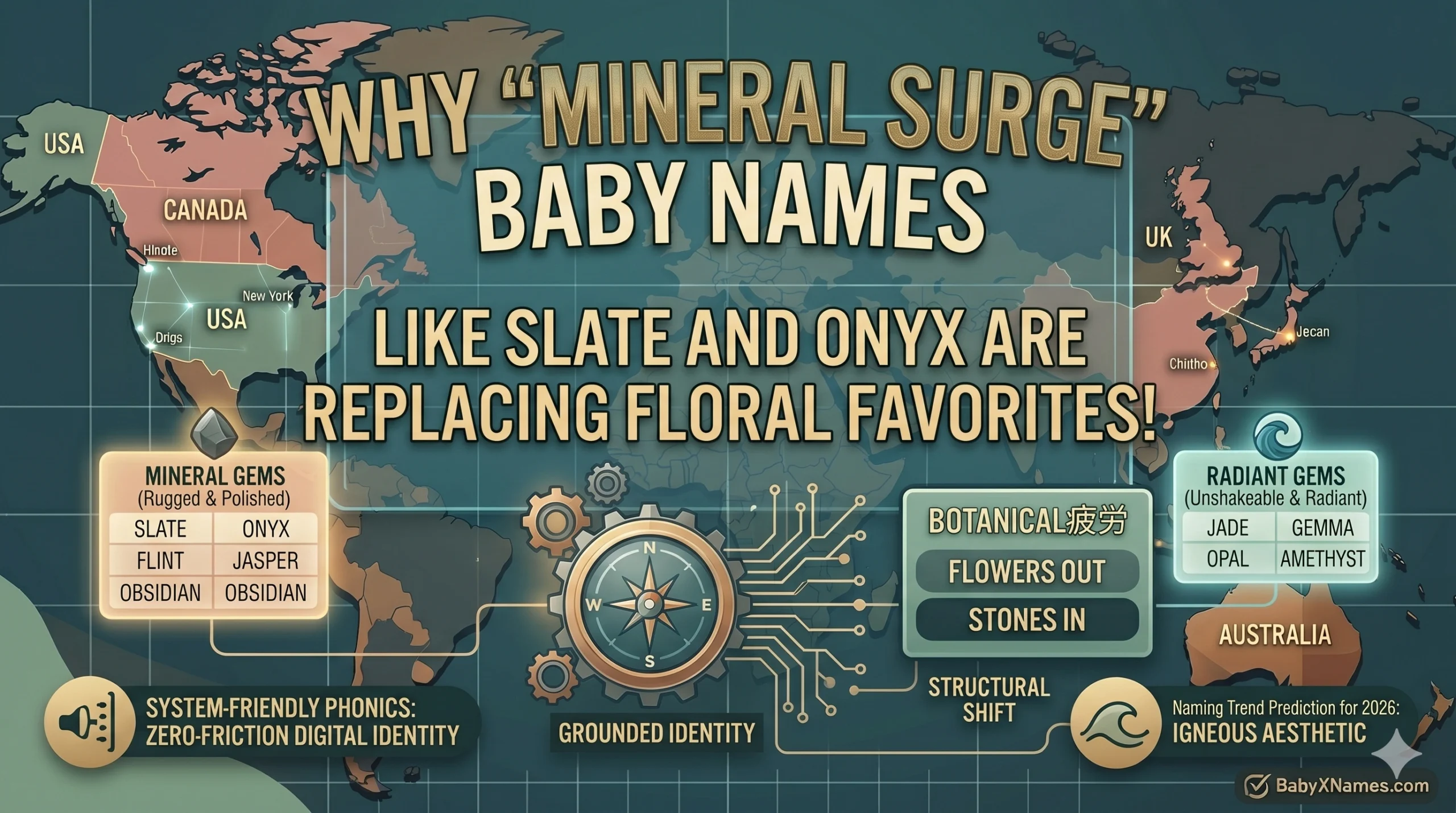
The botanical naming boom that gave us a generation of Lilys, Roses, and Willows is finally meeting its geological match. As we move through 2026, a structural shift in parent preferences is occurring across Tier 1 countries like the USA, Canada, the UK, and Australia. Families are trading soft, organic petals for the architectural strength of the earth. Understanding why “Mineral Surge” baby names like Slate and Onyx are replacing floral favorites is essential for parents looking to solve the modern “naming dilemma.” This trend represents a move toward “Grounded Onomastics”—a desire for names that feel permanent, unshakeable, and phonetically locked.
Choosing a name from the earth’s crust provides a sense of “Quiet Luxury.” While floral names suggest a fleeting, seasonal beauty, mineral names imply a legacy that spans eons. In a digital-first world, these monikers offer a “zero-friction” identity: they are short, easy to spell, and carry a high-status, modern edge that thrives in professional and social registries alike.
From Botanical Softness to Geological Strength
For years, nature names were synonymous with the garden. However, the over-saturation of floral names has led to “botanical fatigue.” Parents in 2026 are seeking a different kind of natural connection—one that feels more rugged and less “frilly.” This is the core reason why “Mineral Surge” baby names like Slate and Onyx are replacing floral favorites.
Mineral names provide a “harder” phonetic profile. They often utilize sharp, decisive consonants like ‘T’, ‘K’, and ‘X’. This linguistic stability makes them incredibly “system-friendly.” Unlike creative spellings of floral names, a mineral name is a dictionary-defined noun, ensuring that AI voice assistants and digital registries never mangle the orthography.
15 “Mineral Surge” Names for Boys (Rugged & Polished)
These selections prioritize architectural strength and brevity, making them the new standard for the “Global Executive” aesthetic.
- 1. Slate
- Origin: English.
- Meaning: A fine-grained, grey metamorphic rock.
- Why it’s trending in 2026: It is the quintessential “Clean Onomastics” choice. It is one syllable, visually balanced, and suggests a sleek, modern professional brand.
- 2. Onyx
- Origin: Greek.
- Meaning: A banded variety of chalcedony (gemstone).
- Why it’s trending in 2026: The ‘X’ ending is the ultimate status symbol this year. It feels ancient yet futuristic, fitting the 2026 “Cyber-Classic” vibe.
- 3. Flint
- Origin: English.
- Meaning: A hard, sedimentary form of quartz used to strike fire.
- Why it’s trending in 2026: It represents “Functional Nature.” It sounds rugged, capable, and is impossible to misspell in any digital registry.
- 4. Jasper
- Origin: Persian.
- Meaning: Treasurer or “spotted stone.”
- Why it’s trending in 2026: It serves as the “bridge name” between the floral era and the mineral surge, maintaining a vintage charm with a stony core.
- 5. Obsidian
- Origin: Latin.
- Meaning: Volcanic glass.
- Why it’s trending in 2026: For parents who want more “syllable prestige,” Obsidian offers a dramatic, high-impact alternative to shorter names.
- 6. Stone (English – “Solid rock”)
- 7. Shale (English – “Layered rock”)
- 8. Quartz (German/Greek – “Hard mineral”)
- 9. Clay (English – “Earthly material”)
- 10. Jet (English – “Intense black gemstone”)
- 11. Steel (English – “Strong alloy”)
- 12. Granite (Latin – “Grained stone”)
- 13. Rock (English – “Solid mass”)
- 14. Pyre (Greek – “Fire/Spark stone”)
- 15. Mica (Latin – “To glitter/Grain”)
15 “Mineral Surge” Names for Girls (Radiant & Unshakeable)
These names move away from “soft” feminine tropes toward a “Sculptural Beauty” that feels grounded and intelligent.
- 16. Jade
- Origin: Spanish/Latin.
- Meaning: Stone of the side (healing stone).
- Why it’s trending in 2026: A classic that has found new life in the “Mineral Surge.” It is the “perfect” one-way spelling name.
- 17. Gemma
- Origin: Italian/Latin.
- Meaning: Precious stone or bud.
- Why it’s trending in 2026: It feels international and sophisticated, working seamlessly across London, Toronto, and Sydney.
- 18. Opal
- Origin: Sanskrit.
- Meaning: Precious gem.
- Why it’s trending in 2026: Part of the “Vintage Minimalist” revival. It is rare but follows perfect, intuitive spelling rules.
- 19. Amethyst
- Origin: Greek.
- Meaning: Not intoxicated (purple quartz).
- Why it’s trending in 2026: It offers a bohemian-luxe alternative to names like Violet or Lavender.
- 20. Ruby
- Origin: Latin.
- Meaning: Red.
- Why it’s trending in 2026: While older than some trends, its inclusion in the “Mineral Surge” keeps it at the top of the “Radiant” charts.
- 21. Emerald (Persian/Greek – “Green gemstone”)
- 22. Sapphire (Hebrew/Greek – “Blue stone”)
- 23. Beryl (Greek – “Sea-green jewel”)
- 24. Diamond (Greek – “Invincible”)
- 25. Pearl (Latin – “Precious gem of the sea”)
- 26. Amber (Arabic/Latin – “Fossilized resin”)
- 27. Crystal (Greek – “Ice/Clear mineral”)
- 28. Esme (French/Persian – “Emerald/Esteemed”)
- 29. Petra (Greek – “Rock/Stone”)
- 30. Larimar (Spanish – “Sea stone”)
Pro-Tip: The “Geological Sound” Check
When choosing a mineral name, pair it with a “softer” middle name to create phonetic balance. For example, Slate Alexander or Jade Elizabeth combines the modern, rugged edge of the “Mineral Surge” with the rhythmic flow of a classic multi-syllabic middle name.
Naming Trend Prediction for 2026: The “Igneous” Aesthetic
As we head into the final quarters of 2026, we predict a move specifically toward “Igneous” or volcanic names. Parents are becoming enamored with the idea of “beauty born from fire.”
Expect to see a rise in monikers like Magma, Basalt, and Pumice in more avant-garde naming circles in Brooklyn and East London. These names represent the extreme end of the “Mineral Surge,” catering to parents who want their child’s name to signify resilience and intense creation.
Frequently Asked Questions (FAQ)
Why are mineral names becoming more popular than floral names?
Floral names have become over-saturated in Tier 1 countries. Parents are seeking “Grounded Onomastics”—names that feel more permanent, gender-neutral, and architecturally strong than traditional botanical choices.
Are mineral names easy to spell for digital registries?
Yes. Most mineral names are dictionary nouns (Slate, Flint, Clay). This makes them “zero-friction” names because their orthography is already standardized in global databases and AI systems.
Can a mineral name be prestigious?
Absolutely. The “Quiet Luxury” movement in 2026 prizes restraint and durability. Mineral names imply a legacy and strength that many parents find more “high-status” than decorative or overly long traditional names.