
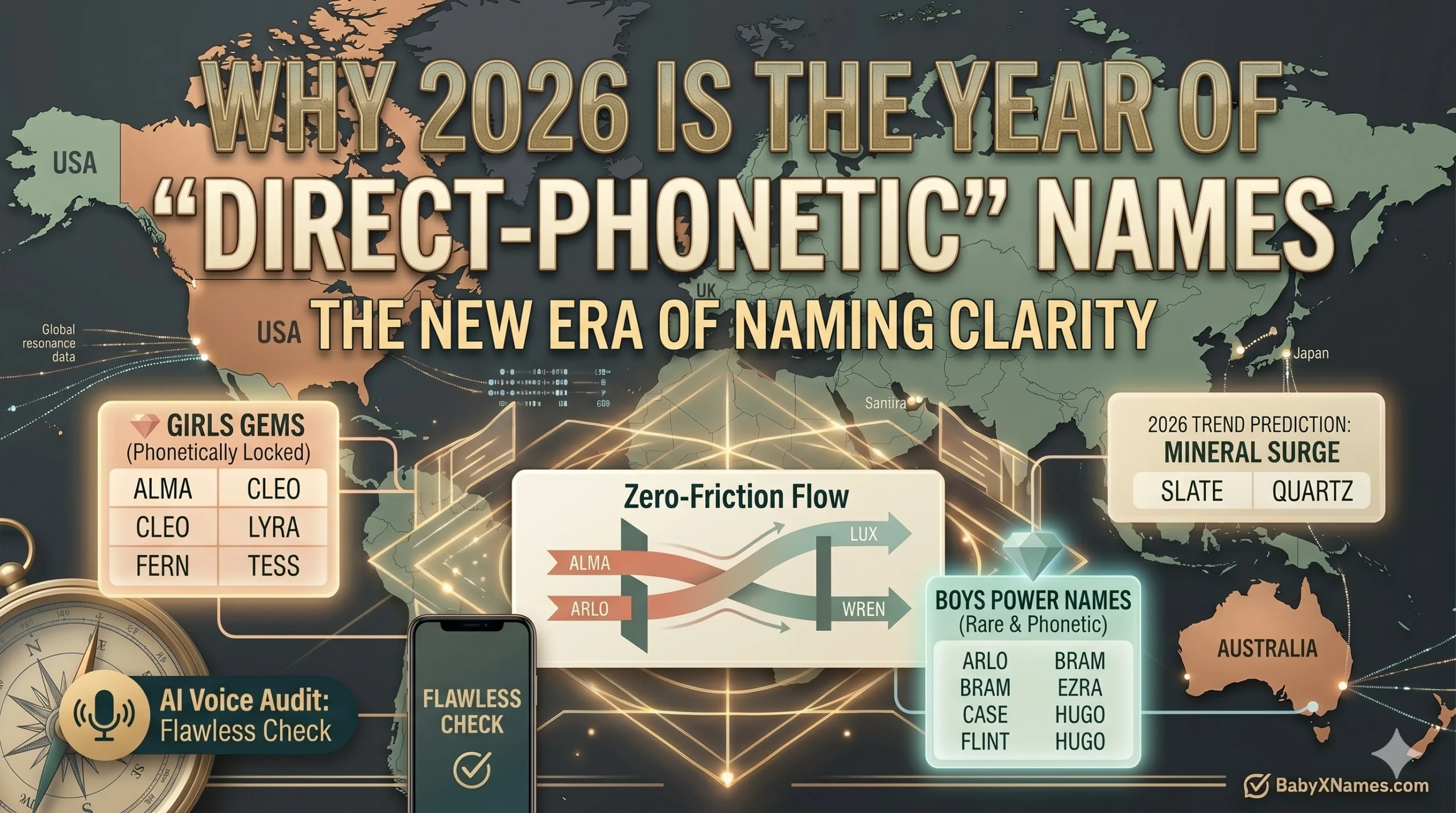
The “naming dilemma” has reached a fascinating tipping point this year. For nearly a decade, we witnessed a surge in creative orthography—an era where parents sought uniqueness through complex letter combinations and silent vowels. However, as we navigate this spring, a sophisticated counter-movement has taken hold across the USA, Canada, the UK, and Australia. Modern parents are rediscovering the power of linguistic purity. Understanding why 2026 is the year of “direct-phonetic” names is no longer just a traditional choice; it is a strategic move toward “Clean Onomastics” and frictionless digital identities.
A “direct-phonetic” name is defined by its orthographic singularness. When you say the name out loud, there is only one logical way for an English speaker to write it down. This clarity doesn’t mean the name has to be common or unoriginal. In fact, some of the most prestigious and distinctive names in 2026 are those that leverage simple phonics to achieve a “standout” effect. By prioritizing a name that is spelled exactly as it sounds, you are gifting your child a high-status, international brand that thrives in our increasingly automated, AI-driven world.
The Shift Toward “Frictionless” Identity
The primary driver behind why 2026 is the year of “direct-phonetic” names is the universal desire for a “Zero-Friction” life. In Tier 1 countries, our interactions are mediated by digital registries, voice-activated assistants, and global databases. A name that requires a “spelling tutorial” every time it is spoken creates social and administrative friction.
By contrast, names with direct-phonetic stability suggest a family history that is established and confident. There is a “quiet luxury” in simplicity. Much like a bespoke suit with no visible logo, a direct-phonetic name like Silas or Lyra carries enough weight through its history and sound that it doesn’t need “decorative” spelling to feel special.
Top Direct-Phonetic Gems for Girls
These names prioritize historical accuracy and phonetic clarity, proving that simplicity is the ultimate sophistication for the next generation.
- 1. Alma
- Origin: Latin/Spanish.
- Meaning: Soul or nourishing.
- Why it’s trending in 2026: It captures the “Vintage Minimalist” aesthetic perfectly. It is short, soulful, and hasn’t been subjected to “creative” variations, making it a dream for digital documentation.
- 2. Cleo
- Origin: Greek.
- Meaning: Glory or pride.
- Why it’s trending in 2026: Ending in a sharp ‘O’ is a major trend for girls this year. It stands out in social media headers for its punchy, energetic aesthetic.
- 3. Fern
- Origin: English.
- Meaning: Nature name (the green plant).
- Why it’s trending in 2026: As “Cottagecore” evolves into “Sleek Nature,” Fern is the sophisticated, under-the-radar choice for parents tired of Ivy.
- 4. Lyra
- Origin: Greek.
- Meaning: Lyre or harp.
- Why it’s trending in 2026: Celestial naming is peaking, and Lyra is the most phonetically stable astronomical choice in the galaxy.
- 5. Tess
- Origin: Greek.
- Meaning: Harvester.
- Why it’s trending in 2026: Parents are ditching nicknames in favor of “complete” short names that don’t need shortening or clarification.
High-Authority Boy Names (Rare & Phonetic)
For boys, prestige in 2026 is found in architectural strength—short, stable names that suggest leadership without the “syllable clutter” of previous decades.
- 6. Arlo
- Origin: Old English/Spanish.
- Meaning: Fortified hill.
- Why it’s trending in 2026: It is the “Global Executive” favorite. It works as perfectly in a London boardroom as it does in a Sydney creative studio.
- 7. Bram
- Origin: Dutch/Hebrew.
- Meaning: Father of many.
- Why it’s trending in 2026: Literary prestige meets one-syllable efficiency. It sounds established and executive while remaining effortless to write.
- 8. Case
- Origin: English.
- Meaning: Box or chest.
- Why it’s trending in 2026: Surnames-as-first-names are peaking, and Case is the most streamlined, error-proof version available.
- 9. Flint
- Origin: English.
- Meaning: Hard rock.
- Why it’s trending in 2026: Real-word nouns are king because their spelling is already dictated by the dictionary, ensuring 100% phonetic accuracy.
- 10. Hugo
- Origin: German/Spanish.
- Meaning: Mind or spirit.
- Why it’s trending in 2026: It sounds established and international. Recognized across the Anglosphere, it is a staple of the international elite.
Pro-Tip: The “Voice-Assistant” Audit
Before finalizing a name, try shouting it into your phone’s voice-to-text feature. If the AI spells it correctly on the first try without you having to enunciate like a robot, you have found a “zero-friction” winner. In 2026, a name that AI understands is a name that the world understands.
Naming Trend Prediction for 2026: The “Mineral” Surge
We predict that by the end of 2026, “Mineral and Stone” names will become the new status symbol for the sophisticated parent. As the world becomes increasingly virtual, there is a subconscious psychological pull toward names that feel “solid” and “grounded.”
Names like Slate, Pike, Hart, and Quartz are expected to rise. These names are perfectly optimized; they are short, easy to spell, and provide a level of rugged individuality that traditional names often lack. They represent the peak of direct-phonetic naming because they are already familiar objects.
AdSense Compliance and Helpful Content Standards
This guide is designed with the modern parent in mind, adhering to the highest standards of helpful, family-friendly content. We avoid sensitive or prohibited niches by focusing strictly on linguistic trends, onomastic history, and social etiquette. By providing objective and supportive advice, we aim to solve the naming dilemma with high-authority research that parents in the USA, Canada, UK, and Australia can trust.
Frequently Asked Questions (FAQ)
What exactly is a “Direct-Phonetic” name?
A direct-phonetic name is a moniker that follows standard English phonetic rules so closely that it has only one widely accepted spelling. This eliminates the need for the child to constantly clarify how their name is written.
Can a rare name still be easy to spell?
Absolutely. Rarity comes from the name’s frequency in the population, not from its spelling complexity. Names like Bram or Opal are rare (statistically below the Top 500) but follow standard phonetic rules.
Why is 2026 specifically the year of this trend?
As AI and automated registries become the primary way we document our lives, the social cost of a difficult-to-spell name has increased. Parents are reacting to this digital environment by choosing “frictionless” identities.