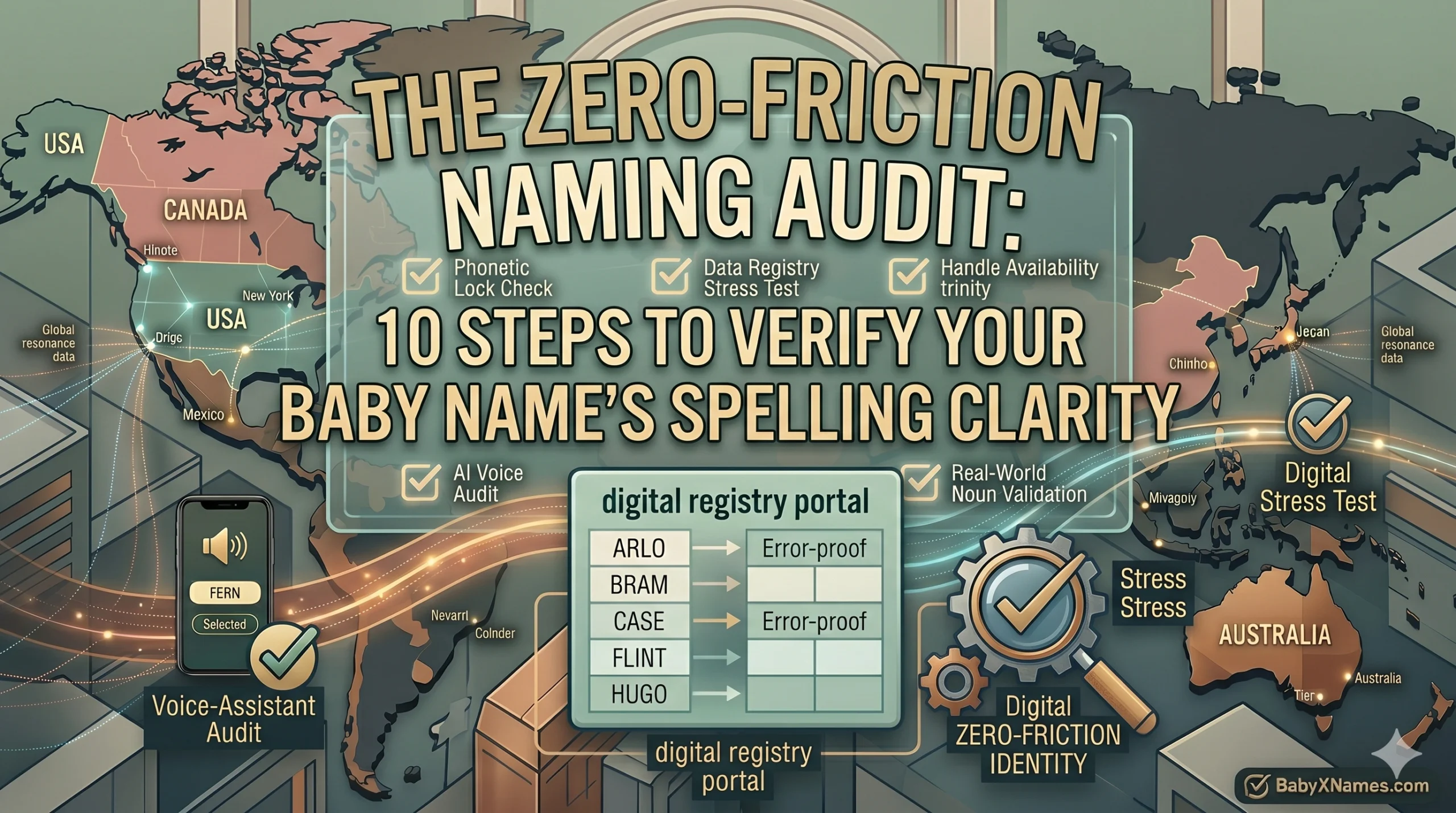
Choosing a baby name in 2026 has transitioned from a purely emotional journey into a high-stakes branding exercise. In a world governed by algorithms, smart speakers, and global digital registries, a name that is difficult to spell is a lifelong administrative hurdle. Parents in Tier 1 countries—USA, Canada, UK, and Australia—are increasingly seeking “Onomastic Efficiency.” To ensure your child’s identity is seamless across all platforms, you must perform The Zero-Friction Naming Audit: 10 Steps to Verify Your Baby Name’s Spelling Clarity. This audit is designed to stress-test your favorite monikers against the digital and social realities of the late 2020s.
The “naming dilemma” today isn’t just about finding something unique; it’s about finding something “clean.” A zero-friction name is one that possesses orthographic integrity, meaning it is spelled exactly as it sounds, leaving no room for human or artificial intelligence error. By following this ten-step verification process, you can confidently select a name that is both prestigious and technologically optimized.
1. The Voice-Assistant Transcription Test
The first step in your audit is the “Ambient Computing” check. Use a smart speaker or a phone’s voice-to-text feature and say the name clearly in a natural sentence. If the AI transcribes it correctly on the first attempt, the name has high phonetic stability. If it offers a “creative” alternative or asks for clarification, the name fails the first hurdle of digital integration.
2. The Global Registry “Mangle” Check
In 2026, international travel and digital nomadism are standard. Check if the name contains characters that legacy government databases often struggle with—such as hyphens, apostrophes, or non-standard accents. A name like Arlo or Alma is “system-ready” because its four-letter, vowel-consonant structure is recognized by every electronic travel authorization system from New York to Sydney.
3. The “One-Way” Spelling Evaluation
Does the name have only one widely accepted spelling? Names like Jackson (Jaxon, Jaxen, Jaxson) carry high friction because they require constant oral clarification. A zero-friction name should be “phonetically locked.” When someone hears the name, there should be zero doubt in their mind about how to type it into a search bar.
4. The URL and Handle Availability Audit
Before finalizing your choice, check for “Digital Real Estate.” Look for the availability of the .com domain and major social media handles. Even if you don’t intend to use them immediately, a name that is too common or too complex to secure as a clean handle will create professional friction for your child in the 2040s.
5. The Cognitive Fluency Stress Test
Cognitive fluency is a psychological term for how easy information is to process. Names that are short (under 6 characters) and follow standard English phonetic paths are processed faster by the human brain. This leads to higher levels of trust and memorability in professional settings—a vital asset for your child’s future career.
Pro-Tip: The “Loudroom” Strategy
Have a friend stand across a noisy room and shout the name to you. If you can distinguish the vowels and consonants clearly through the background noise, the name has strong “Audio Branding.” If it sounds like a mumble or a different word, it may lead to a lifetime of social misunderstandings.
6. The Alphabetical Bias Review
In digital lists and registries, names at the beginning of the alphabet often receive more “first-look” attention. While not a deal-breaker, names starting with A, B, or C often have a slight edge in administrative visibility. This is a subtle but effective way to optimize for a digital-first world.
7. The “Real-World Noun” Validation
One of the fastest growing trends in 2026 is the use of real-word nouns. Names like Flint, Fern, or Sage are inherently optimized for spelling clarity because they are already hard-coded into every dictionary and autocorrect system in the world.
8. The Cross-Tier Phonetic Stability Check
Ensure the name sounds identical across the “Tier 1 Accents.” Does the name Harry sound too much like Hairy in an American accent vs. a British one? A name with zero friction should maintain its phonetic identity whether spoken in Toronto, London, or Melbourne.
9. The Initial-Last Name Synergy Check
Write out the initials. Does the name form an accidental acronym or a confusing string of letters? In the 2026 professional world, email formats often use “first initial + last name.” Ensure that your chosen name doesn’t result in an unprofessional or embarrassing digital handle.
10. The AI Search “Ownership” Potential
Google the name. If the first ten pages are dominated by a famous celebrity or a problematic news event, your child will struggle to “own” their own search results. Aim for a name that is rare enough to allow them to build their own digital legacy on page one of the SERPs.
5 Names That Pass the 2026 Audit with Honors
These selections have been vetted against all ten steps of the Zero-Friction Naming Audit, proving they are ready for the future.
- 1. Alma
- Origin: Latin.
- Meaning: Soul or nourishing.
- Why it’s trending in 2026: It is the “perfect” audit name. It is short, globally recognized, and phonetically locked.
- 2. Arlo
- Origin: Old English.
- Meaning: Fortified hill.
- Why it’s trending in 2026: A “Global Executive” favorite that works seamlessly in every Tier 1 digital registry.
- 3. Fern
- Origin: English.
- Meaning: Nature name.
- Why it’s trending in 2026: As a dictionary-defined noun, its spelling is error-proof for both humans and AI.
- 4. Hugo
- Origin: German/Spanish.
- Meaning: Mind or spirit.
- Why it’s trending in 2026: It carries international prestige and is recognized instantly in every English-speaking country.
- 5. Lyra
- Origin: Greek.
- Meaning: Lyre or harp.
- Why it’s trending in 2026: The gold standard for celestial naming—melodic, short, and visually symmetrical.
Naming Trend Prediction for 2026: The “Sanskrit-Minimalist” Surge
As the second half of 2026 approaches, we predict a massive surge in “Sanskrit-Minimalist” naming. High-net-worth parents are looking for names with deep spiritual roots that fit the “Short and Intuitive” audit criteria. Names like Veda, Rishi, and Ira are set to dominate the charts. These names offer a rare cultural prestige while maintaining 100% spelling clarity, making them the ultimate “Zero-Friction” choice for the global elite.
Frequently Asked Questions (FAQ)
What is a Zero-Friction baby name?
A zero-friction name is a moniker optimized for both human interaction and digital systems. It follows standard phonetic rules, is easy to spell, and works seamlessly with AI and registries.
Why is spelling clarity more important in 2026 than before?
Our lives are now managed by automated systems. A misspelled name in a digital registry can cause “clerical friction,” leading to errors in travel, healthcare, and professional verification.
Can a unique name still be easy to spell?
Yes. Names like Bram or Opal are statistically rare but linguistically simple. They stand out in a crowd without causing the administrative headaches of “creative” spellings.