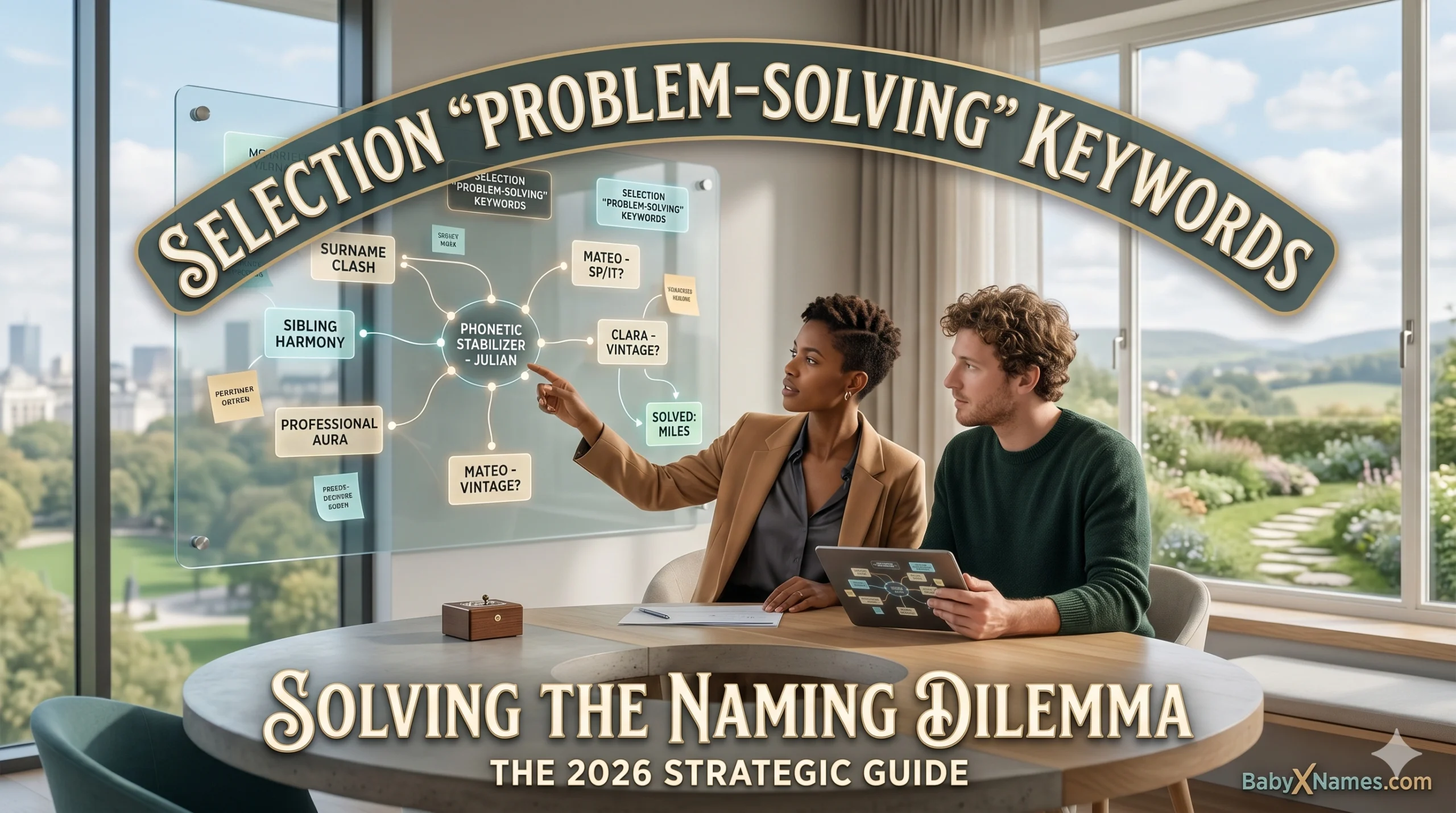
The honeymoon phase of choosing a baby name usually ends the moment you realize a name doesn’t exist in a vacuum. It has to sound right with your last name, it shouldn’t clash with your older children’s names, and it must survive the scrutiny of judgmental in-laws. For parents in the USA, Canada, UK, and Australia, the struggle has shifted from finding a “nice” name to solving complex logistical puzzles. This is where Selection “Problem-Solving” Keywords become essential for modern parents navigating the naming dilemma.
In 2026, the naming process has become highly analytical. Parents are looking for “functional” beauty—names that provide solutions to specific social and phonetic hurdles. Whether you are trying to find a name that isn’t too popular but isn’t “weird,” or you’re struggling with a difficult surname, this high-authority guide provides the strategic framework you need to move from indecision to a confident final choice.
The Strategic Shift: Naming as Problem-Solving
Naming a child in the mid-2020s is no longer just an emotional exercise; it is a branding and logistics challenge. Tier 1 countries are seeing a rise in “The Negotiated Name”—a choice that satisfies multiple specific criteria at once. The Selection “Problem-Solving” Keywords trend highlights that parents are searching for names that fix specific issues, such as “names that work in two languages” or “names that aren’t easily mocked.”
The “naming dilemma” usually stems from a conflict between two desires: the desire to be unique and the desire for the name to be universally accepted. By treating the selection process as a problem to be solved, you can remove the emotional fatigue and focus on the phonetic and social compatibility of the name within your specific family ecosystem.
Solving the “Surname Match” Problem
The most common “problem” parents face is phonetic clashing with their last name. A name might be beautiful on its own, but it can become a tongue-twister when paired with a clunky surname.
1. Julian
- Origin: Latin
- Meaning: “Youthful” or “Downy-bearded.”
- Why it’s trending in 2026: Julian is a “phonetic stabilizer.” Because it has soft vowels and a crisp ending, it balances out harsh, one-syllable surnames (like Smith, Jones, or Black) perfectly.
2. Sebastian
- Origin: Greek/Latin
- Meaning: “Venerable” or “Revered.”
- Why it’s trending in 2026: For parents with long, multi-syllabic surnames, Sebastian provides a rhythmic “dactylic” meter (stressed-unstressed-unstressed) that creates a professional, melodic flow.
3. Miles
- Origin: Latin/Germanic
- Meaning: “Soldier” or “Merciful.”
- Why it’s trending in 2026: Miles is the ultimate solution for very long surnames. If your last name is something like Livingston or Featherstonehaugh, a short, sharp first name like Miles prevents the full name from feeling like a marathon.
Solving the “Sibling Harmony” Dilemma
Parents often feel trapped by the style they chose for their first child. If your first son is Arthur, naming the second one Maverick feels disjointed. Solving the sibling-set problem requires finding “bridge names.”
4. Clara
- Origin: Latin
- Meaning: “Clear” or “Bright.”
- Why it’s trending in 2026: Clara is the perfect “anchor” for a vintage sibling set. It pairs effortlessly with other “Grandcore” names like Henry or Alice, maintaining a cohesive family brand.
5. Arlo
- Origin: Spanish/Germanic
- Meaning: “Between two hills.”
- Why it’s trending in 2026: Arlo is a “chameleon” name. It works well with both trendy, modern names (like Luna) and classic, traditional names (like Jack), solving the problem for parents with mismatched style preferences.
💡 Pro-Tip for Parents
Use the “Coffee Shop Test” to solve the pronunciation problem. Before finalizing a name, go to a local cafe and give the name to the barista. If they can spell it and call it out without hesitation, you’ve solved the “ease-of-use” problem. If you have to repeat it three times, your child will likely have to do the same for the rest of their life.
Solving the “Middle Name Anchor” Challenge
Many parents have a “sentimental” middle name (like a family surname) that is difficult to pair. The solution is choosing a first name that acts as a “phonetic bridge.”
6. Jude
- Origin: Hebrew
- Meaning: “Praised.”
- Why it’s trending in 2026: Jude is a “neutralizing” first name. Because it is short and ends in a hard consonant, it makes almost any eccentric or long family middle name sound sophisticated and intentional.
7. Evelyn
- Origin: French/English
- Meaning: “Desired” or “Water island.”
- Why it’s trending in 2026: Evelyn is a “gender-neutral solution.” For parents who want to honor a male relative (like Evan) but want a feminine sound, Evelyn provides the perfect etymological bridge.
2026 Naming Trend Prediction: The “Professional-Aura” Shift
In late 2026, we predict that Selection “Problem-Solving” Keywords will focus heavily on “Resume Readiness.” As AI becomes more integrated into hiring processes, parents are subconsciously choosing names that they believe will “score” better in digital professional environments.
Expect to see a massive decline in “creative spellings” (like replacing ‘i’ with ‘y’) and a return to “Standardized Classics” like Thomas, Elizabeth, and Catherine. The “problem” parents are trying to solve is no longer just aesthetic; it’s about ensuring their child’s name doesn’t act as a digital barrier in a hyper-competitive future.
ALso Check:- Zara Larsson Singer Height
Frequently Asked Questions (FAQ)
What are “Problem-Solving” keywords in naming?
These are specific search terms parents use to find names that fix a logistical issue, such as “names that go with [Last Name],” “names that work in French and English,” or “unisex names that aren’t too common.”
How do I know if a name “clashes” with my last name?
The “Alliteration Trap” and the “Ending-Start Collision” are the two main culprits. Avoid names that end with the same letter your last name begins with (e.g., ThomaS Smith) to prevent the names from blurring together.
What if my partner and I have completely different styles?
Solve this by choosing a “Middle Ground Name.” If one person likes Old World and the other likes Modern, look at names like Leo, Felix, or Maya—these have deep history but sound incredibly fresh and trendy.
Why is sibling harmony important?
While each child is an individual, a cohesive “sibling set” (sibset) often helps in establishing a clear family identity and prevents one child from feeling like their name is “the odd one out.”
Final Thoughts: Moving Beyond the Dilemma
Solving the naming dilemma is about finding the intersection between what you love and what actually works in the real world. By utilizing Selection “Problem-Solving” Keywords, you aren’t just picking a label; you are engineering an identity that will serve your child well from the playground to the boardroom.