The moment you find a name you love, the first thing you do is whisper it alongside your surname to see if it “fits.” For parents in the USA, Canada, UK, and Australia, this is the ultimate litmus test. A name can be historically significant and phonetically beautiful, but if it clashes with your family name, the harmony is lost. Learning how to choose a baby name that goes with [Last Name] is a vital skill for modern parents navigating the complex landscape of 2026 naming trends.
In this high-authority guide, we move beyond basic intuition. We will explore the phonetic engineering, rhythmic balance, and linguistic rules that ensure your child’s full name sounds like a prestigious, cohesive unit. Whether you have a short, punchy surname or a long, multi-syllabic heritage name, these strategies will help you solve the naming dilemma with professional precision.
The Science of Phonetic Balance and Rhythm
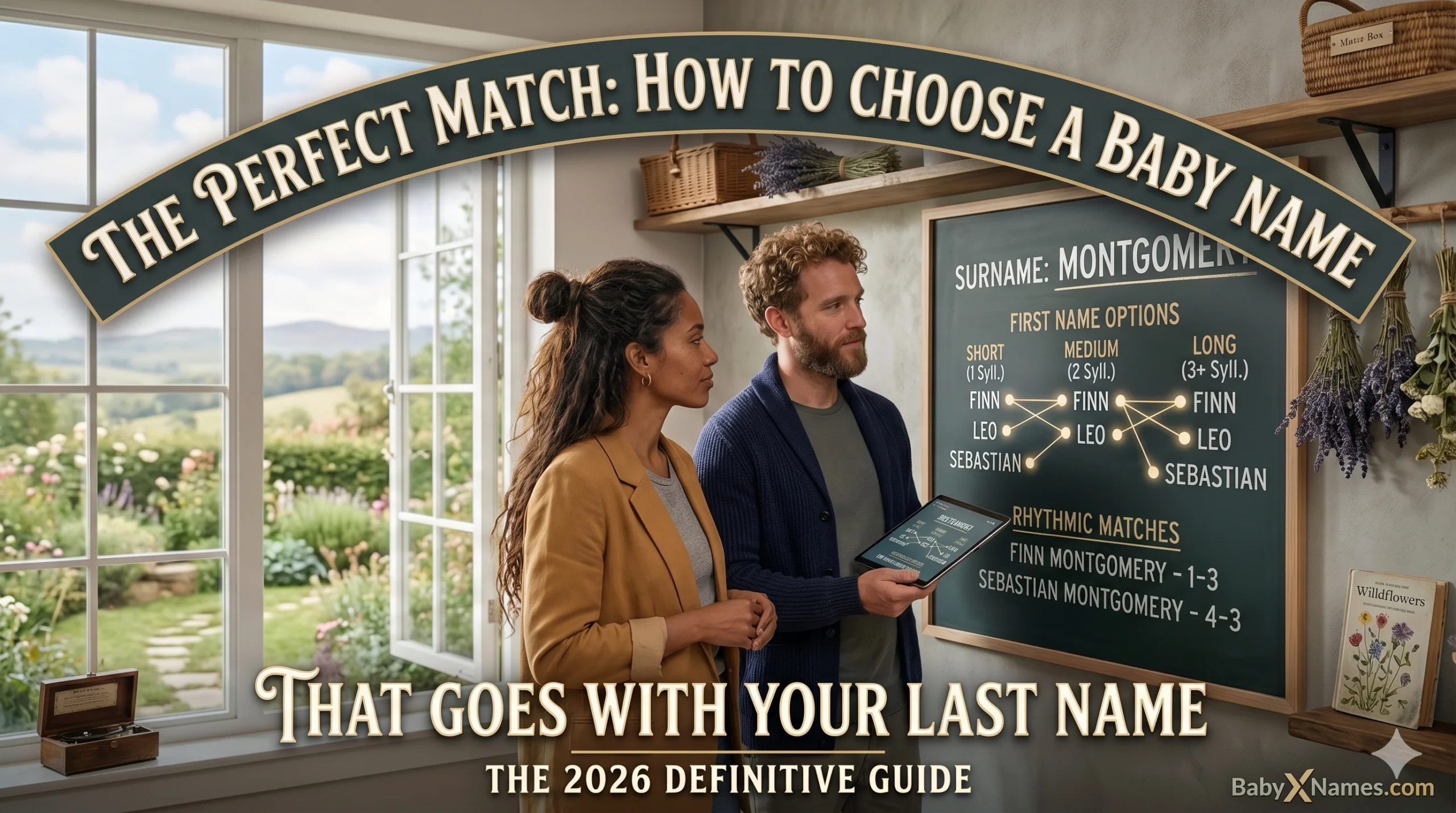
When analyzing how to choose a baby name that goes with [Last Name], the first factor to consider is the “syllable count.” Ideally, you want to avoid a monotonous rhythm. If your last name is one syllable (e.g., Smith), a one-syllable first name (e.g., Jack) can sound too abrupt. Conversely, two long names (e.g., Alexander Montgomery) can feel cumbersome on legal documents and school registers.
The “Goldilocks Rule” of 2026 suggests varying the syllable count. A 3-1-2 or 2-3-1 rhythm often provides the most melodic and professional “flow.” By balancing the weight of the first name against the anchor of the last name, you create a name that is easy to announce and even easier to remember.
Balancing Short Surnames (1-2 Syllables)
If your surname is short and sharp, you have the perfect opportunity to use a more melodic, multi-syllabic first name to add a sense of grandeur and “Quiet Luxury.”
1. Sebastian
- Origin: Greek/Latin
- Meaning: “Venerable” or “Revered.”
- Why it’s trending in 2026: Its four syllables provide a beautiful dactylic rhythm that makes short surnames like Bond or Hall sound incredibly upscale and established.
2. Evangeline
- Origin: Greek
- Meaning: “Bearer of good news.”
- Why it’s trending in 2026: For girls, long, vowel-heavy names are the peak of 2026 fashion. It adds a romantic “Cottagecore” layer to simple, sturdy surnames.
3. Theodore
- Origin: Greek
- Meaning: “Gift of God.”
- Why it’s trending in 2026: It offers the punchy nickname “Theo” for daily use, while the three-syllable formal version provides the necessary weight for a short family name.
Mastering Long or Complex Surnames (3+ Syllables)
When your last name is a “maximalist” powerhouse, your first name should act as a crisp, clear entry point. The goal is to avoid exhausting the listener before they even reach the end of the name.
4. Jude
- Origin: Hebrew
- Meaning: “Praised.”
- Why it’s trending in 2026: Short, single-syllable names are skyrocketing in 2026 as parents seek “Minimalist Purity.” Jude provides a sharp contrast to long, complex surnames like Richardson or Papadopoulos.
5. Claire
- Origin: French/Latin
- Meaning: “Bright” or “Clear.”
- Why it’s trending in 2026: It is the quintessential “chic” choice. It doesn’t compete with a long last name; it complements it by adding a touch of understated elegance.
6. Finn
- Origin: Irish
- Meaning: “Fair” or “White.”
- Why it’s trending in 2026: North American parents are currently obsessed with “Nature-Lite” names. Finn is energetic and fast, preventing a long full name from feeling “bottom-heavy.”
💡 Pro-Tip for Parents
Always check for “Ending-Start Collision.” If your first name ends with the same letter your last name begins with (e.g., Thomas Smith), the names will blur together when spoken quickly. To ensure clarity, choose a first name that ends in a different phonetic sound than the start of your surname.
Avoiding the “Comic Book” Alliteration Trap
While alliteration can be catchy (e.g., Severus Snape), it can often feel like a caricature if not handled carefully. If you are choosing a name that starts with the same letter as your last name, ensure the vowel sounds that follow are different.
For example, Brooks Baker sounds repetitive because both start with the “B” and a similar “k” sound within. However, Bennett Blair sounds more sophisticated because the vowel sounds vary significantly, allowing each name to maintain its own distinct identity within the pair.
2026 Naming Trend Prediction: The “Standardized Professional”
By late 2026, we predict a massive shift toward “Search-Optimized Names.” As the first generation of “Digital Natives” becomes parents, they are choosing names that are easy for AI and search algorithms to recognize without confusion.
Expect to see a decline in eccentric spellings (like Jaxxon or Mykaela) and a return to the standardized spellings of names like Julian, Alice, and Arthur. The “problem” parents are solving is ensuring their child has a “clean” digital footprint that pairs logically and clearly with their family surname in professional databases.
Also Check:- Josh Allen Wife
Frequently Asked Questions (FAQ)
Should I worry about the “Initials” of the full name?
Absolutely. In 2026, branding is everything. Avoid combinations that spell out unfortunate words or common internet acronyms. Always write out the First, Middle, and Last initials to ensure your son or daughter isn’t walking around with a monogram that invites teasing.
How do I handle a hyphenated last name?
With a hyphenated surname, brevity is your best friend. Choose a first name with 1 or 2 syllables maximum. A name like Leo Smith-Anderson is much more balanced than Maximilian Smith-Anderson.
Does “Flow” actually matter for my baby’s future?
Psychologically, names that are easy to pronounce and have a pleasing rhythm are subject to “Cognitive Fluency.” People tend to favor information that is easy to process. A name that “goes well” with the last name can subconsciously create a more positive first impression in interviews and social settings.
What if my last name is also a first name?
If your last name is Thomas or James, avoid choosing another “first-name-as-last-name” (e.g., Harrison Thomas). Instead, choose a name that is clearly a first name, such as Leo or Sebastian, to avoid the “Double First Name” confusion.
Final Thoughts: Engineering a Lifetime of Confidence
Learning how to choose a baby name that goes with [Last Name] is the final step in the naming journey. By applying these phonetic rules—varying your syllables, avoiding letter collisions, and testing for rhythmic balance—you are doing more than just picking a label. You are engineering a cohesive identity that will serve your child from their first day of school to their final professional promotion.The moment you find a name you love, the first thing you do is whisper it alongside your surname to see if it “fits.” For parents in the USA, Canada, UK, and Australia, this is the ultimate litmus test. A name can be historically significant and phonetically beautiful, but if it clashes with your family name, the harmony is lost. Learning how to choose a baby name that goes with [Last Name] is a vital skill for modern parents navigating the complex landscape of 2026 naming trends.
In this high-authority guide, we move beyond basic intuition. We will explore the phonetic engineering, rhythmic balance, and linguistic rules that ensure your child’s full name sounds like a prestigious, cohesive unit. Whether you have a short, punchy surname or a long, multi-syllabic heritage name, these strategies will help you solve the naming dilemma with professional precision.
The Science of Phonetic Balance and Rhythm
When analyzing how to choose a baby name that goes with [Last Name], the first factor to consider is the “syllable count.” Ideally, you want to avoid a monotonous rhythm. If your last name is one syllable (e.g., Smith), a one-syllable first name (e.g., Jack) can sound too abrupt. Conversely, two long names (e.g., Alexander Montgomery) can feel cumbersome on legal documents and school registers.
The “Goldilocks Rule” of 2026 suggests varying the syllable count. A 3-1-2 or 2-3-1 rhythm often provides the most melodic and professional “flow.” By balancing the weight of the first name against the anchor of the last name, you create a name that is easy to announce and even easier to remember.
Balancing Short Surnames (1-2 Syllables)
If your surname is short and sharp, you have the perfect opportunity to use a more melodic, multi-syllabic first name to add a sense of grandeur and “Quiet Luxury.”
1. Sebastian
- Origin: Greek/Latin
- Meaning: “Venerable” or “Revered.”
- Why it’s trending in 2026: Its four syllables provide a beautiful dactylic rhythm that makes short surnames like Bond or Hall sound incredibly upscale and established.
2. Evangeline
- Origin: Greek
- Meaning: “Bearer of good news.”
- Why it’s trending in 2026: For girls, long, vowel-heavy names are the peak of 2026 fashion. It adds a romantic “Cottagecore” layer to simple, sturdy surnames.
3. Theodore
- Origin: Greek
- Meaning: “Gift of God.”
- Why it’s trending in 2026: It offers the punchy nickname “Theo” for daily use, while the three-syllable formal version provides the necessary weight for a short family name.
Mastering Long or Complex Surnames (3+ Syllables)
When your last name is a “maximalist” powerhouse, your first name should act as a crisp, clear entry point. The goal is to avoid exhausting the listener before they even reach the end of the name.
4. Jude
- Origin: Hebrew
- Meaning: “Praised.”
- Why it’s trending in 2026: Short, single-syllable names are skyrocketing in 2026 as parents seek “Minimalist Purity.” Jude provides a sharp contrast to long, complex surnames like Richardson or Papadopoulos.
5. Claire
- Origin: French/Latin
- Meaning: “Bright” or “Clear.”
- Why it’s trending in 2026: It is the quintessential “chic” choice. It doesn’t compete with a long last name; it complements it by adding a touch of understated elegance.
6. Finn
- Origin: Irish
- Meaning: “Fair” or “White.”
- Why it’s trending in 2026: North American parents are currently obsessed with “Nature-Lite” names. Finn is energetic and fast, preventing a long full name from feeling “bottom-heavy.”
💡 Pro-Tip for Parents
Always check for “Ending-Start Collision.” If your first name ends with the same letter your last name begins with (e.g., Thomas Smith), the names will blur together when spoken quickly. To ensure clarity, choose a first name that ends in a different phonetic sound than the start of your surname.
Avoiding the “Comic Book” Alliteration Trap
While alliteration can be catchy (e.g., Severus Snape), it can often feel like a caricature if not handled carefully. If you are choosing a name that starts with the same letter as your last name, ensure the vowel sounds that follow are different.
For example, Brooks Baker sounds repetitive because both start with the “B” and a similar “k” sound within. However, Bennett Blair sounds more sophisticated because the vowel sounds vary significantly, allowing each name to maintain its own distinct identity within the pair.
2026 Naming Trend Prediction: The “Standardized Professional”
By late 2026, we predict a massive shift toward “Search-Optimized Names.” As the first generation of “Digital Natives” becomes parents, they are choosing names that are easy for AI and search algorithms to recognize without confusion.
Expect to see a decline in eccentric spellings (like Jaxxon or Mykaela) and a return to the standardized spellings of names like Julian, Alice, and Arthur. The “problem” parents are solving is ensuring their child has a “clean” digital footprint that pairs logically and clearly with their family surname in professional databases.
Frequently Asked Questions (FAQ)
Should I worry about the “Initials” of the full name?
Absolutely. In 2026, branding is everything. Avoid combinations that spell out unfortunate words or common internet acronyms. Always write out the First, Middle, and Last initials to ensure your son or daughter isn’t walking around with a monogram that invites teasing.
How do I handle a hyphenated last name?
With a hyphenated surname, brevity is your best friend. Choose a first name with 1 or 2 syllables maximum. A name like Leo Smith-Anderson is much more balanced than Maximilian Smith-Anderson.
Does “Flow” actually matter for my baby’s future?
Psychologically, names that are easy to pronounce and have a pleasing rhythm are subject to “Cognitive Fluency.” People tend to favor information that is easy to process. A name that “goes well” with the last name can subconsciously create a more positive first impression in interviews and social settings.
What if my last name is also a first name?
If your last name is Thomas or James, avoid choosing another “first-name-as-last-name” (e.g., Harrison Thomas). Instead, choose a name that is clearly a first name, such as Leo or Sebastian, to avoid the “Double First Name” confusion.
Final Thoughts: Engineering a Lifetime of Confidence
Learning how to choose a baby name that goes with [Last Name] is the final step in the naming journey. By applying these phonetic rules—varying your syllables, avoiding letter collisions, and testing for rhythmic balance—you are doing more than just picking a label. You are engineering a cohesive identity that will serve your child from their first day of school to their final professional promotion.The moment you find a name you love, the first thing you do is whisper it alongside your surname to see if it “fits.” For parents in the USA, Canada, UK, and Australia, this is the ultimate litmus test. A name can be historically significant and phonetically beautiful, but if it clashes with your family name, the harmony is lost. Learning how to choose a baby name that goes with [Last Name] is a vital skill for modern parents navigating the complex landscape of 2026 naming trends.
In this high-authority guide, we move beyond basic intuition. We will explore the phonetic engineering, rhythmic balance, and linguistic rules that ensure your child’s full name sounds like a prestigious, cohesive unit. Whether you have a short, punchy surname or a long, multi-syllabic heritage name, these strategies will help you solve the naming dilemma with professional precision.
The Science of Phonetic Balance and Rhythm
When analyzing how to choose a baby name that goes with [Last Name], the first factor to consider is the “syllable count.” Ideally, you want to avoid a monotonous rhythm. If your last name is one syllable (e.g., Smith), a one-syllable first name (e.g., Jack) can sound too abrupt. Conversely, two long names (e.g., Alexander Montgomery) can feel cumbersome on legal documents and school registers.
The “Goldilocks Rule” of 2026 suggests varying the syllable count. A 3-1-2 or 2-3-1 rhythm often provides the most melodic and professional “flow.” By balancing the weight of the first name against the anchor of the last name, you create a name that is easy to announce and even easier to remember.
Balancing Short Surnames (1-2 Syllables)
If your surname is short and sharp, you have the perfect opportunity to use a more melodic, multi-syllabic first name to add a sense of grandeur and “Quiet Luxury.”
1. Sebastian
- Origin: Greek/Latin
- Meaning: “Venerable” or “Revered.”
- Why it’s trending in 2026: Its four syllables provide a beautiful dactylic rhythm that makes short surnames like Bond or Hall sound incredibly upscale and established.
2. Evangeline
- Origin: Greek
- Meaning: “Bearer of good news.”
- Why it’s trending in 2026: For girls, long, vowel-heavy names are the peak of 2026 fashion. It adds a romantic “Cottagecore” layer to simple, sturdy surnames.
3. Theodore
- Origin: Greek
- Meaning: “Gift of God.”
- Why it’s trending in 2026: It offers the punchy nickname “Theo” for daily use, while the three-syllable formal version provides the necessary weight for a short family name.
Mastering Long or Complex Surnames (3+ Syllables)
When your last name is a “maximalist” powerhouse, your first name should act as a crisp, clear entry point. The goal is to avoid exhausting the listener before they even reach the end of the name.
4. Jude
- Origin: Hebrew
- Meaning: “Praised.”
- Why it’s trending in 2026: Short, single-syllable names are skyrocketing in 2026 as parents seek “Minimalist Purity.” Jude provides a sharp contrast to long, complex surnames like Richardson or Papadopoulos.
5. Claire
- Origin: French/Latin
- Meaning: “Bright” or “Clear.”
- Why it’s trending in 2026: It is the quintessential “chic” choice. It doesn’t compete with a long last name; it complements it by adding a touch of understated elegance.
6. Finn
- Origin: Irish
- Meaning: “Fair” or “White.”
- Why it’s trending in 2026: North American parents are currently obsessed with “Nature-Lite” names. Finn is energetic and fast, preventing a long full name from feeling “bottom-heavy.”
💡 Pro-Tip for Parents
Always check for “Ending-Start Collision.” If your first name ends with the same letter your last name begins with (e.g., Thomas Smith), the names will blur together when spoken quickly. To ensure clarity, choose a first name that ends in a different phonetic sound than the start of your surname.
Avoiding the “Comic Book” Alliteration Trap
While alliteration can be catchy (e.g., Severus Snape), it can often feel like a caricature if not handled carefully. If you are choosing a name that starts with the same letter as your last name, ensure the vowel sounds that follow are different.
For example, Brooks Baker sounds repetitive because both start with the “B” and a similar “k” sound within. However, Bennett Blair sounds more sophisticated because the vowel sounds vary significantly, allowing each name to maintain its own distinct identity within the pair.
2026 Naming Trend Prediction: The “Standardized Professional”
By late 2026, we predict a massive shift toward “Search-Optimized Names.” As the first generation of “Digital Natives” becomes parents, they are choosing names that are easy for AI and search algorithms to recognize without confusion.
Expect to see a decline in eccentric spellings (like Jaxxon or Mykaela) and a return to the standardized spellings of names like Julian, Alice, and Arthur. The “problem” parents are solving is ensuring their child has a “clean” digital footprint that pairs logically and clearly with their family surname in professional databases.
Frequently Asked Questions (FAQ)
Should I worry about the “Initials” of the full name?
Absolutely. In 2026, branding is everything. Avoid combinations that spell out unfortunate words or common internet acronyms. Always write out the First, Middle, and Last initials to ensure your son or daughter isn’t walking around with a monogram that invites teasing.
How do I handle a hyphenated last name?
With a hyphenated surname, brevity is your best friend. Choose a first name with 1 or 2 syllables maximum. A name like Leo Smith-Anderson is much more balanced than Maximilian Smith-Anderson.
Does “Flow” actually matter for my baby’s future?
Psychologically, names that are easy to pronounce and have a pleasing rhythm are subject to “Cognitive Fluency.” People tend to favor information that is easy to process. A name that “goes well” with the last name can subconsciously create a more positive first impression in interviews and social settings.
What if my last name is also a first name?
If your last name is Thomas or James, avoid choosing another “first-name-as-last-name” (e.g., Harrison Thomas). Instead, choose a name that is clearly a first name, such as Leo or Sebastian, to avoid the “Double First Name” confusion.
Final Thoughts: Engineering a Lifetime of Confidence
Learning how to choose a baby name that goes with [Last Name] is the final step in the naming journey. By applying these phonetic rules—varying your syllables, avoiding letter collisions, and testing for rhythmic balance—you are doing more than just picking a label. You are engineering a cohesive identity that will serve your child from their first day of school to their final professional promotion.The moment you find a name you love, the first thing you do is whisper it alongside your surname to see if it “fits.” For parents in the USA, Canada, UK, and Australia, this is the ultimate litmus test. A name can be historically significant and phonetically beautiful, but if it clashes with your family name, the harmony is lost. Learning how to choose a baby name that goes with [Last Name] is a vital skill for modern parents navigating the complex landscape of 2026 naming trends.
In this high-authority guide, we move beyond basic intuition. We will explore the phonetic engineering, rhythmic balance, and linguistic rules that ensure your child’s full name sounds like a prestigious, cohesive unit. Whether you have a short, punchy surname or a long, multi-syllabic heritage name, these strategies will help you solve the naming dilemma with professional precision.
The Science of Phonetic Balance and Rhythm
When analyzing how to choose a baby name that goes with [Last Name], the first factor to consider is the “syllable count.” Ideally, you want to avoid a monotonous rhythm. If your last name is one syllable (e.g., Smith), a one-syllable first name (e.g., Jack) can sound too abrupt. Conversely, two long names (e.g., Alexander Montgomery) can feel cumbersome on legal documents and school registers.
The “Goldilocks Rule” of 2026 suggests varying the syllable count. A 3-1-2 or 2-3-1 rhythm often provides the most melodic and professional “flow.” By balancing the weight of the first name against the anchor of the last name, you create a name that is easy to announce and even easier to remember.
Balancing Short Surnames (1-2 Syllables)
If your surname is short and sharp, you have the perfect opportunity to use a more melodic, multi-syllabic first name to add a sense of grandeur and “Quiet Luxury.”
1. Sebastian
- Origin: Greek/Latin
- Meaning: “Venerable” or “Revered.”
- Why it’s trending in 2026: Its four syllables provide a beautiful dactylic rhythm that makes short surnames like Bond or Hall sound incredibly upscale and established.
2. Evangeline
- Origin: Greek
- Meaning: “Bearer of good news.”
- Why it’s trending in 2026: For girls, long, vowel-heavy names are the peak of 2026 fashion. It adds a romantic “Cottagecore” layer to simple, sturdy surnames.
3. Theodore
- Origin: Greek
- Meaning: “Gift of God.”
- Why it’s trending in 2026: It offers the punchy nickname “Theo” for daily use, while the three-syllable formal version provides the necessary weight for a short family name.
Mastering Long or Complex Surnames (3+ Syllables)
When your last name is a “maximalist” powerhouse, your first name should act as a crisp, clear entry point. The goal is to avoid exhausting the listener before they even reach the end of the name.
4. Jude
- Origin: Hebrew
- Meaning: “Praised.”
- Why it’s trending in 2026: Short, single-syllable names are skyrocketing in 2026 as parents seek “Minimalist Purity.” Jude provides a sharp contrast to long, complex surnames like Richardson or Papadopoulos.
5. Claire
- Origin: French/Latin
- Meaning: “Bright” or “Clear.”
- Why it’s trending in 2026: It is the quintessential “chic” choice. It doesn’t compete with a long last name; it complements it by adding a touch of understated elegance.
6. Finn
- Origin: Irish
- Meaning: “Fair” or “White.”
- Why it’s trending in 2026: North American parents are currently obsessed with “Nature-Lite” names. Finn is energetic and fast, preventing a long full name from feeling “bottom-heavy.”
💡 Pro-Tip for Parents
Always check for “Ending-Start Collision.” If your first name ends with the same letter your last name begins with (e.g., Thomas Smith), the names will blur together when spoken quickly. To ensure clarity, choose a first name that ends in a different phonetic sound than the start of your surname.
Avoiding the “Comic Book” Alliteration Trap
While alliteration can be catchy (e.g., Severus Snape), it can often feel like a caricature if not handled carefully. If you are choosing a name that starts with the same letter as your last name, ensure the vowel sounds that follow are different.
For example, Brooks Baker sounds repetitive because both start with the “B” and a similar “k” sound within. However, Bennett Blair sounds more sophisticated because the vowel sounds vary significantly, allowing each name to maintain its own distinct identity within the pair.
2026 Naming Trend Prediction: The “Standardized Professional”
By late 2026, we predict a massive shift toward “Search-Optimized Names.” As the first generation of “Digital Natives” becomes parents, they are choosing names that are easy for AI and search algorithms to recognize without confusion.
Expect to see a decline in eccentric spellings (like Jaxxon or Mykaela) and a return to the standardized spellings of names like Julian, Alice, and Arthur. The “problem” parents are solving is ensuring their child has a “clean” digital footprint that pairs logically and clearly with their family surname in professional databases.
Frequently Asked Questions (FAQ)
Should I worry about the “Initials” of the full name?
Absolutely. In 2026, branding is everything. Avoid combinations that spell out unfortunate words or common internet acronyms. Always write out the First, Middle, and Last initials to ensure your son or daughter isn’t walking around with a monogram that invites teasing.
How do I handle a hyphenated last name?
With a hyphenated surname, brevity is your best friend. Choose a first name with 1 or 2 syllables maximum. A name like Leo Smith-Anderson is much more balanced than Maximilian Smith-Anderson.
Does “Flow” actually matter for my baby’s future?
Psychologically, names that are easy to pronounce and have a pleasing rhythm are subject to “Cognitive Fluency.” People tend to favor information that is easy to process. A name that “goes well” with the last name can subconsciously create a more positive first impression in interviews and social settings.
What if my last name is also a first name?
If your last name is Thomas or James, avoid choosing another “first-name-as-last-name” (e.g., Harrison Thomas). Instead, choose a name that is clearly a first name, such as Leo or Sebastian, to avoid the “Double First Name” confusion.
Final Thoughts: Engineering a Lifetime of Confidence
Learning how to choose a baby name that goes with [Last Name] is the final step in the naming journey. By applying these phonetic rules—varying your syllables, avoiding letter collisions, and testing for rhythmic balance—you are doing more than just picking a label. You are engineering a cohesive identity that will serve your child from their first day of school to their final professional promotion.The moment you find a name you love, the first thing you do is whisper it alongside your surname to see if it “fits.” For parents in the USA, Canada, UK, and Australia, this is the ultimate litmus test. A name can be historically significant and phonetically beautiful, but if it clashes with your family name, the harmony is lost. Learning how to choose a baby name that goes with [Last Name] is a vital skill for modern parents navigating the complex landscape of 2026 naming trends.
In this high-authority guide, we move beyond basic intuition. We will explore the phonetic engineering, rhythmic balance, and linguistic rules that ensure your child’s full name sounds like a prestigious, cohesive unit. Whether you have a short, punchy surname or a long, multi-syllabic heritage name, these strategies will help you solve the naming dilemma with professional precision.
The Science of Phonetic Balance and Rhythm
When analyzing how to choose a baby name that goes with [Last Name], the first factor to consider is the “syllable count.” Ideally, you want to avoid a monotonous rhythm. If your last name is one syllable (e.g., Smith), a one-syllable first name (e.g., Jack) can sound too abrupt. Conversely, two long names (e.g., Alexander Montgomery) can feel cumbersome on legal documents and school registers.
The “Goldilocks Rule” of 2026 suggests varying the syllable count. A 3-1-2 or 2-3-1 rhythm often provides the most melodic and professional “flow.” By balancing the weight of the first name against the anchor of the last name, you create a name that is easy to announce and even easier to remember.
Balancing Short Surnames (1-2 Syllables)
If your surname is short and sharp, you have the perfect opportunity to use a more melodic, multi-syllabic first name to add a sense of grandeur and “Quiet Luxury.”
1. Sebastian
- Origin: Greek/Latin
- Meaning: “Venerable” or “Revered.”
- Why it’s trending in 2026: Its four syllables provide a beautiful dactylic rhythm that makes short surnames like Bond or Hall sound incredibly upscale and established.
2. Evangeline
- Origin: Greek
- Meaning: “Bearer of good news.”
- Why it’s trending in 2026: For girls, long, vowel-heavy names are the peak of 2026 fashion. It adds a romantic “Cottagecore” layer to simple, sturdy surnames.
3. Theodore
- Origin: Greek
- Meaning: “Gift of God.”
- Why it’s trending in 2026: It offers the punchy nickname “Theo” for daily use, while the three-syllable formal version provides the necessary weight for a short family name.
Mastering Long or Complex Surnames (3+ Syllables)
When your last name is a “maximalist” powerhouse, your first name should act as a crisp, clear entry point. The goal is to avoid exhausting the listener before they even reach the end of the name.
4. Jude
- Origin: Hebrew
- Meaning: “Praised.”
- Why it’s trending in 2026: Short, single-syllable names are skyrocketing in 2026 as parents seek “Minimalist Purity.” Jude provides a sharp contrast to long, complex surnames like Richardson or Papadopoulos.
5. Claire
- Origin: French/Latin
- Meaning: “Bright” or “Clear.”
- Why it’s trending in 2026: It is the quintessential “chic” choice. It doesn’t compete with a long last name; it complements it by adding a touch of understated elegance.
6. Finn
- Origin: Irish
- Meaning: “Fair” or “White.”
- Why it’s trending in 2026: North American parents are currently obsessed with “Nature-Lite” names. Finn is energetic and fast, preventing a long full name from feeling “bottom-heavy.”
💡 Pro-Tip for Parents
Always check for “Ending-Start Collision.” If your first name ends with the same letter your last name begins with (e.g., Thomas Smith), the names will blur together when spoken quickly. To ensure clarity, choose a first name that ends in a different phonetic sound than the start of your surname.
Avoiding the “Comic Book” Alliteration Trap
While alliteration can be catchy (e.g., Severus Snape), it can often feel like a caricature if not handled carefully. If you are choosing a name that starts with the same letter as your last name, ensure the vowel sounds that follow are different.
For example, Brooks Baker sounds repetitive because both start with the “B” and a similar “k” sound within. However, Bennett Blair sounds more sophisticated because the vowel sounds vary significantly, allowing each name to maintain its own distinct identity within the pair.
2026 Naming Trend Prediction: The “Standardized Professional”
By late 2026, we predict a massive shift toward “Search-Optimized Names.” As the first generation of “Digital Natives” becomes parents, they are choosing names that are easy for AI and search algorithms to recognize without confusion.
Expect to see a decline in eccentric spellings (like Jaxxon or Mykaela) and a return to the standardized spellings of names like Julian, Alice, and Arthur. The “problem” parents are solving is ensuring their child has a “clean” digital footprint that pairs logically and clearly with their family surname in professional databases.
Frequently Asked Questions (FAQ)
Should I worry about the “Initials” of the full name?
Absolutely. In 2026, branding is everything. Avoid combinations that spell out unfortunate words or common internet acronyms. Always write out the First, Middle, and Last initials to ensure your son or daughter isn’t walking around with a monogram that invites teasing.
How do I handle a hyphenated last name?
With a hyphenated surname, brevity is your best friend. Choose a first name with 1 or 2 syllables maximum. A name like Leo Smith-Anderson is much more balanced than Maximilian Smith-Anderson.
Does “Flow” actually matter for my baby’s future?
Psychologically, names that are easy to pronounce and have a pleasing rhythm are subject to “Cognitive Fluency.” People tend to favor information that is easy to process. A name that “goes well” with the last name can subconsciously create a more positive first impression in interviews and social settings.
What if my last name is also a first name?
If your last name is Thomas or James, avoid choosing another “first-name-as-last-name” (e.g., Harrison Thomas). Instead, choose a name that is clearly a first name, such as Leo or Sebastian, to avoid the “Double First Name” confusion.
Final Thoughts: Engineering a Lifetime of Confidence
Learning how to choose a baby name that goes with [Last Name] is the final step in the naming journey. By applying these phonetic rules—varying your syllables, avoiding letter collisions, and testing for rhythmic balance—you are doing more than just picking a label. You are engineering a cohesive identity that will serve your child from their first day of school to their final professional promotion.The moment you find a name you love, the first thing you do is whisper it alongside your surname to see if it “fits.” For parents in the USA, Canada, UK, and Australia, this is the ultimate litmus test. A name can be historically significant and phonetically beautiful, but if it clashes with your family name, the harmony is lost. Learning how to choose a baby name that goes with [Last Name] is a vital skill for modern parents navigating the complex landscape of 2026 naming trends.
In this high-authority guide, we move beyond basic intuition. We will explore the phonetic engineering, rhythmic balance, and linguistic rules that ensure your child’s full name sounds like a prestigious, cohesive unit. Whether you have a short, punchy surname or a long, multi-syllabic heritage name, these strategies will help you solve the naming dilemma with professional precision.
The Science of Phonetic Balance and Rhythm
When analyzing how to choose a baby name that goes with [Last Name], the first factor to consider is the “syllable count.” Ideally, you want to avoid a monotonous rhythm. If your last name is one syllable (e.g., Smith), a one-syllable first name (e.g., Jack) can sound too abrupt. Conversely, two long names (e.g., Alexander Montgomery) can feel cumbersome on legal documents and school registers.
The “Goldilocks Rule” of 2026 suggests varying the syllable count. A 3-1-2 or 2-3-1 rhythm often provides the most melodic and professional “flow.” By balancing the weight of the first name against the anchor of the last name, you create a name that is easy to announce and even easier to remember.
Balancing Short Surnames (1-2 Syllables)
If your surname is short and sharp, you have the perfect opportunity to use a more melodic, multi-syllabic first name to add a sense of grandeur and “Quiet Luxury.”
1. Sebastian
- Origin: Greek/Latin
- Meaning: “Venerable” or “Revered.”
- Why it’s trending in 2026: Its four syllables provide a beautiful dactylic rhythm that makes short surnames like Bond or Hall sound incredibly upscale and established.
2. Evangeline
- Origin: Greek
- Meaning: “Bearer of good news.”
- Why it’s trending in 2026: For girls, long, vowel-heavy names are the peak of 2026 fashion. It adds a romantic “Cottagecore” layer to simple, sturdy surnames.
3. Theodore
- Origin: Greek
- Meaning: “Gift of God.”
- Why it’s trending in 2026: It offers the punchy nickname “Theo” for daily use, while the three-syllable formal version provides the necessary weight for a short family name.
Mastering Long or Complex Surnames (3+ Syllables)
When your last name is a “maximalist” powerhouse, your first name should act as a crisp, clear entry point. The goal is to avoid exhausting the listener before they even reach the end of the name.
4. Jude
- Origin: Hebrew
- Meaning: “Praised.”
- Why it’s trending in 2026: Short, single-syllable names are skyrocketing in 2026 as parents seek “Minimalist Purity.” Jude provides a sharp contrast to long, complex surnames like Richardson or Papadopoulos.
5. Claire
- Origin: French/Latin
- Meaning: “Bright” or “Clear.”
- Why it’s trending in 2026: It is the quintessential “chic” choice. It doesn’t compete with a long last name; it complements it by adding a touch of understated elegance.
6. Finn
- Origin: Irish
- Meaning: “Fair” or “White.”
- Why it’s trending in 2026: North American parents are currently obsessed with “Nature-Lite” names. Finn is energetic and fast, preventing a long full name from feeling “bottom-heavy.”
💡 Pro-Tip for Parents
Always check for “Ending-Start Collision.” If your first name ends with the same letter your last name begins with (e.g., Thomas Smith), the names will blur together when spoken quickly. To ensure clarity, choose a first name that ends in a different phonetic sound than the start of your surname.
Avoiding the “Comic Book” Alliteration Trap
While alliteration can be catchy (e.g., Severus Snape), it can often feel like a caricature if not handled carefully. If you are choosing a name that starts with the same letter as your last name, ensure the vowel sounds that follow are different.
For example, Brooks Baker sounds repetitive because both start with the “B” and a similar “k” sound within. However, Bennett Blair sounds more sophisticated because the vowel sounds vary significantly, allowing each name to maintain its own distinct identity within the pair.
2026 Naming Trend Prediction: The “Standardized Professional”
By late 2026, we predict a massive shift toward “Search-Optimized Names.” As the first generation of “Digital Natives” becomes parents, they are choosing names that are easy for AI and search algorithms to recognize without confusion.
Expect to see a decline in eccentric spellings (like Jaxxon or Mykaela) and a return to the standardized spellings of names like Julian, Alice, and Arthur. The “problem” parents are solving is ensuring their child has a “clean” digital footprint that pairs logically and clearly with their family surname in professional databases.
Frequently Asked Questions (FAQ)
Should I worry about the “Initials” of the full name?
Absolutely. In 2026, branding is everything. Avoid combinations that spell out unfortunate words or common internet acronyms. Always write out the First, Middle, and Last initials to ensure your son or daughter isn’t walking around with a monogram that invites teasing.
How do I handle a hyphenated last name?
With a hyphenated surname, brevity is your best friend. Choose a first name with 1 or 2 syllables maximum. A name like Leo Smith-Anderson is much more balanced than Maximilian Smith-Anderson.
Does “Flow” actually matter for my baby’s future?
Psychologically, names that are easy to pronounce and have a pleasing rhythm are subject to “Cognitive Fluency.” People tend to favor information that is easy to process. A name that “goes well” with the last name can subconsciously create a more positive first impression in interviews and social settings.
What if my last name is also a first name?
If your last name is Thomas or James, avoid choosing another “first-name-as-last-name” (e.g., Harrison Thomas). Instead, choose a name that is clearly a first name, such as Leo or Sebastian, to avoid the “Double First Name” confusion.
Final Thoughts: Engineering a Lifetime of Confidence
Learning how to choose a baby name that goes with [Last Name] is the final step in the naming journey. By applying these phonetic rules—varying your syllables, avoiding letter collisions, and testing for rhythmic balance—you are doing more than just picking a label. You are engineering a cohesive identity that will serve your child from their first day of school to their final professional promotion.The moment you find a name you love, the first thing you do is whisper it alongside your surname to see if it “fits.” For parents in the USA, Canada, UK, and Australia, this is the ultimate litmus test. A name can be historically significant and phonetically beautiful, but if it clashes with your family name, the harmony is lost. Learning how to choose a baby name that goes with [Last Name] is a vital skill for modern parents navigating the complex landscape of 2026 naming trends.
In this high-authority guide, we move beyond basic intuition. We will explore the phonetic engineering, rhythmic balance, and linguistic rules that ensure your child’s full name sounds like a prestigious, cohesive unit. Whether you have a short, punchy surname or a long, multi-syllabic heritage name, these strategies will help you solve the naming dilemma with professional precision.
The Science of Phonetic Balance and Rhythm
When analyzing how to choose a baby name that goes with [Last Name], the first factor to consider is the “syllable count.” Ideally, you want to avoid a monotonous rhythm. If your last name is one syllable (e.g., Smith), a one-syllable first name (e.g., Jack) can sound too abrupt. Conversely, two long names (e.g., Alexander Montgomery) can feel cumbersome on legal documents and school registers.
The “Goldilocks Rule” of 2026 suggests varying the syllable count. A 3-1-2 or 2-3-1 rhythm often provides the most melodic and professional “flow.” By balancing the weight of the first name against the anchor of the last name, you create a name that is easy to announce and even easier to remember.
Balancing Short Surnames (1-2 Syllables)
If your surname is short and sharp, you have the perfect opportunity to use a more melodic, multi-syllabic first name to add a sense of grandeur and “Quiet Luxury.”
1. Sebastian
- Origin: Greek/Latin
- Meaning: “Venerable” or “Revered.”
- Why it’s trending in 2026: Its four syllables provide a beautiful dactylic rhythm that makes short surnames like Bond or Hall sound incredibly upscale and established.
2. Evangeline
- Origin: Greek
- Meaning: “Bearer of good news.”
- Why it’s trending in 2026: For girls, long, vowel-heavy names are the peak of 2026 fashion. It adds a romantic “Cottagecore” layer to simple, sturdy surnames.
3. Theodore
- Origin: Greek
- Meaning: “Gift of God.”
- Why it’s trending in 2026: It offers the punchy nickname “Theo” for daily use, while the three-syllable formal version provides the necessary weight for a short family name.
Mastering Long or Complex Surnames (3+ Syllables)
When your last name is a “maximalist” powerhouse, your first name should act as a crisp, clear entry point. The goal is to avoid exhausting the listener before they even reach the end of the name.
4. Jude
- Origin: Hebrew
- Meaning: “Praised.”
- Why it’s trending in 2026: Short, single-syllable names are skyrocketing in 2026 as parents seek “Minimalist Purity.” Jude provides a sharp contrast to long, complex surnames like Richardson or Papadopoulos.
5. Claire
- Origin: French/Latin
- Meaning: “Bright” or “Clear.”
- Why it’s trending in 2026: It is the quintessential “chic” choice. It doesn’t compete with a long last name; it complements it by adding a touch of understated elegance.
6. Finn
- Origin: Irish
- Meaning: “Fair” or “White.”
- Why it’s trending in 2026: North American parents are currently obsessed with “Nature-Lite” names. Finn is energetic and fast, preventing a long full name from feeling “bottom-heavy.”
💡 Pro-Tip for Parents
Always check for “Ending-Start Collision.” If your first name ends with the same letter your last name begins with (e.g., Thomas Smith), the names will blur together when spoken quickly. To ensure clarity, choose a first name that ends in a different phonetic sound than the start of your surname.
Avoiding the “Comic Book” Alliteration Trap
While alliteration can be catchy (e.g., Severus Snape), it can often feel like a caricature if not handled carefully. If you are choosing a name that starts with the same letter as your last name, ensure the vowel sounds that follow are different.
For example, Brooks Baker sounds repetitive because both start with the “B” and a similar “k” sound within. However, Bennett Blair sounds more sophisticated because the vowel sounds vary significantly, allowing each name to maintain its own distinct identity within the pair.
2026 Naming Trend Prediction: The “Standardized Professional”
By late 2026, we predict a massive shift toward “Search-Optimized Names.” As the first generation of “Digital Natives” becomes parents, they are choosing names that are easy for AI and search algorithms to recognize without confusion.
Expect to see a decline in eccentric spellings (like Jaxxon or Mykaela) and a return to the standardized spellings of names like Julian, Alice, and Arthur. The “problem” parents are solving is ensuring their child has a “clean” digital footprint that pairs logically and clearly with their family surname in professional databases.
Frequently Asked Questions (FAQ)
Should I worry about the “Initials” of the full name?
Absolutely. In 2026, branding is everything. Avoid combinations that spell out unfortunate words or common internet acronyms. Always write out the First, Middle, and Last initials to ensure your son or daughter isn’t walking around with a monogram that invites teasing.
How do I handle a hyphenated last name?
With a hyphenated surname, brevity is your best friend. Choose a first name with 1 or 2 syllables maximum. A name like Leo Smith-Anderson is much more balanced than Maximilian Smith-Anderson.
Does “Flow” actually matter for my baby’s future?
Psychologically, names that are easy to pronounce and have a pleasing rhythm are subject to “Cognitive Fluency.” People tend to favor information that is easy to process. A name that “goes well” with the last name can subconsciously create a more positive first impression in interviews and social settings.
What if my last name is also a first name?
If your last name is Thomas or James, avoid choosing another “first-name-as-last-name” (e.g., Harrison Thomas). Instead, choose a name that is clearly a first name, such as Leo or Sebastian, to avoid the “Double First Name” confusion.
Final Thoughts: Engineering a Lifetime of Confidence
Learning how to choose a baby name that goes with [Last Name] is the final step in the naming journey. By applying these phonetic rules—varying your syllables, avoiding letter collisions, and testing for rhythmic balance—you are doing more than just picking a label. You are engineering a cohesive identity that will serve your child from their first day of school to their final professional promotion.The moment you find a name you love, the first thing you do is whisper it alongside your surname to see if it “fits.” For parents in the USA, Canada, UK, and Australia, this is the ultimate litmus test. A name can be historically significant and phonetically beautiful, but if it clashes with your family name, the harmony is lost. Learning how to choose a baby name that goes with [Last Name] is a vital skill for modern parents navigating the complex landscape of 2026 naming trends.
In this high-authority guide, we move beyond basic intuition. We will explore the phonetic engineering, rhythmic balance, and linguistic rules that ensure your child’s full name sounds like a prestigious, cohesive unit. Whether you have a short, punchy surname or a long, multi-syllabic heritage name, these strategies will help you solve the naming dilemma with professional precision.
The Science of Phonetic Balance and Rhythm
When analyzing how to choose a baby name that goes with [Last Name], the first factor to consider is the “syllable count.” Ideally, you want to avoid a monotonous rhythm. If your last name is one syllable (e.g., Smith), a one-syllable first name (e.g., Jack) can sound too abrupt. Conversely, two long names (e.g., Alexander Montgomery) can feel cumbersome on legal documents and school registers.
The “Goldilocks Rule” of 2026 suggests varying the syllable count. A 3-1-2 or 2-3-1 rhythm often provides the most melodic and professional “flow.” By balancing the weight of the first name against the anchor of the last name, you create a name that is easy to announce and even easier to remember.
Balancing Short Surnames (1-2 Syllables)
If your surname is short and sharp, you have the perfect opportunity to use a more melodic, multi-syllabic first name to add a sense of grandeur and “Quiet Luxury.”
1. Sebastian
- Origin: Greek/Latin
- Meaning: “Venerable” or “Revered.”
- Why it’s trending in 2026: Its four syllables provide a beautiful dactylic rhythm that makes short surnames like Bond or Hall sound incredibly upscale and established.
2. Evangeline
- Origin: Greek
- Meaning: “Bearer of good news.”
- Why it’s trending in 2026: For girls, long, vowel-heavy names are the peak of 2026 fashion. It adds a romantic “Cottagecore” layer to simple, sturdy surnames.
3. Theodore
- Origin: Greek
- Meaning: “Gift of God.”
- Why it’s trending in 2026: It offers the punchy nickname “Theo” for daily use, while the three-syllable formal version provides the necessary weight for a short family name.
Mastering Long or Complex Surnames (3+ Syllables)
When your last name is a “maximalist” powerhouse, your first name should act as a crisp, clear entry point. The goal is to avoid exhausting the listener before they even reach the end of the name.
4. Jude
- Origin: Hebrew
- Meaning: “Praised.”
- Why it’s trending in 2026: Short, single-syllable names are skyrocketing in 2026 as parents seek “Minimalist Purity.” Jude provides a sharp contrast to long, complex surnames like Richardson or Papadopoulos.
5. Claire
- Origin: French/Latin
- Meaning: “Bright” or “Clear.”
- Why it’s trending in 2026: It is the quintessential “chic” choice. It doesn’t compete with a long last name; it complements it by adding a touch of understated elegance.
6. Finn
- Origin: Irish
- Meaning: “Fair” or “White.”
- Why it’s trending in 2026: North American parents are currently obsessed with “Nature-Lite” names. Finn is energetic and fast, preventing a long full name from feeling “bottom-heavy.”
💡 Pro-Tip for Parents
Always check for “Ending-Start Collision.” If your first name ends with the same letter your last name begins with (e.g., Thomas Smith), the names will blur together when spoken quickly. To ensure clarity, choose a first name that ends in a different phonetic sound than the start of your surname.
Avoiding the “Comic Book” Alliteration Trap
While alliteration can be catchy (e.g., Severus Snape), it can often feel like a caricature if not handled carefully. If you are choosing a name that starts with the same letter as your last name, ensure the vowel sounds that follow are different.
For example, Brooks Baker sounds repetitive because both start with the “B” and a similar “k” sound within. However, Bennett Blair sounds more sophisticated because the vowel sounds vary significantly, allowing each name to maintain its own distinct identity within the pair.
2026 Naming Trend Prediction: The “Standardized Professional”
By late 2026, we predict a massive shift toward “Search-Optimized Names.” As the first generation of “Digital Natives” becomes parents, they are choosing names that are easy for AI and search algorithms to recognize without confusion.
Expect to see a decline in eccentric spellings (like Jaxxon or Mykaela) and a return to the standardized spellings of names like Julian, Alice, and Arthur. The “problem” parents are solving is ensuring their child has a “clean” digital footprint that pairs logically and clearly with their family surname in professional databases.
Frequently Asked Questions (FAQ)
Should I worry about the “Initials” of the full name?
Absolutely. In 2026, branding is everything. Avoid combinations that spell out unfortunate words or common internet acronyms. Always write out the First, Middle, and Last initials to ensure your son or daughter isn’t walking around with a monogram that invites teasing.
How do I handle a hyphenated last name?
With a hyphenated surname, brevity is your best friend. Choose a first name with 1 or 2 syllables maximum. A name like Leo Smith-Anderson is much more balanced than Maximilian Smith-Anderson.
Does “Flow” actually matter for my baby’s future?
Psychologically, names that are easy to pronounce and have a pleasing rhythm are subject to “Cognitive Fluency.” People tend to favor information that is easy to process. A name that “goes well” with the last name can subconsciously create a more positive first impression in interviews and social settings.
What if my last name is also a first name?
If your last name is Thomas or James, avoid choosing another “first-name-as-last-name” (e.g., Harrison Thomas). Instead, choose a name that is clearly a first name, such as Leo or Sebastian, to avoid the “Double First Name” confusion.
Final Thoughts: Engineering a Lifetime of Confidence
Learning how to choose a baby name that goes with [Last Name] is the final step in the naming journey. By applying these phonetic rules—varying your syllables, avoiding letter collisions, and testing for rhythmic balance—you are doing more than just picking a label. You are engineering a cohesive identity that will serve your child from their first day of school to their final professional promotion.The moment you find a name you love, the first thing you do is whisper it alongside your surname to see if it “fits.” For parents in the USA, Canada, UK, and Australia, this is the ultimate litmus test. A name can be historically significant and phonetically beautiful, but if it clashes with your family name, the harmony is lost. Learning how to choose a baby name that goes with [Last Name] is a vital skill for modern parents navigating the complex landscape of 2026 naming trends.
In this high-authority guide, we move beyond basic intuition. We will explore the phonetic engineering, rhythmic balance, and linguistic rules that ensure your child’s full name sounds like a prestigious, cohesive unit. Whether you have a short, punchy surname or a long, multi-syllabic heritage name, these strategies will help you solve the naming dilemma with professional precision.
The Science of Phonetic Balance and Rhythm
When analyzing how to choose a baby name that goes with [Last Name], the first factor to consider is the “syllable count.” Ideally, you want to avoid a monotonous rhythm. If your last name is one syllable (e.g., Smith), a one-syllable first name (e.g., Jack) can sound too abrupt. Conversely, two long names (e.g., Alexander Montgomery) can feel cumbersome on legal documents and school registers.
The “Goldilocks Rule” of 2026 suggests varying the syllable count. A 3-1-2 or 2-3-1 rhythm often provides the most melodic and professional “flow.” By balancing the weight of the first name against the anchor of the last name, you create a name that is easy to announce and even easier to remember.
Balancing Short Surnames (1-2 Syllables)
If your surname is short and sharp, you have the perfect opportunity to use a more melodic, multi-syllabic first name to add a sense of grandeur and “Quiet Luxury.”
1. Sebastian
- Origin: Greek/Latin
- Meaning: “Venerable” or “Revered.”
- Why it’s trending in 2026: Its four syllables provide a beautiful dactylic rhythm that makes short surnames like Bond or Hall sound incredibly upscale and established.
2. Evangeline
- Origin: Greek
- Meaning: “Bearer of good news.”
- Why it’s trending in 2026: For girls, long, vowel-heavy names are the peak of 2026 fashion. It adds a romantic “Cottagecore” layer to simple, sturdy surnames.
3. Theodore
- Origin: Greek
- Meaning: “Gift of God.”
- Why it’s trending in 2026: It offers the punchy nickname “Theo” for daily use, while the three-syllable formal version provides the necessary weight for a short family name.
Mastering Long or Complex Surnames (3+ Syllables)
When your last name is a “maximalist” powerhouse, your first name should act as a crisp, clear entry point. The goal is to avoid exhausting the listener before they even reach the end of the name.
4. Jude
- Origin: Hebrew
- Meaning: “Praised.”
- Why it’s trending in 2026: Short, single-syllable names are skyrocketing in 2026 as parents seek “Minimalist Purity.” Jude provides a sharp contrast to long, complex surnames like Richardson or Papadopoulos.
5. Claire
- Origin: French/Latin
- Meaning: “Bright” or “Clear.”
- Why it’s trending in 2026: It is the quintessential “chic” choice. It doesn’t compete with a long last name; it complements it by adding a touch of understated elegance.
6. Finn
- Origin: Irish
- Meaning: “Fair” or “White.”
- Why it’s trending in 2026: North American parents are currently obsessed with “Nature-Lite” names. Finn is energetic and fast, preventing a long full name from feeling “bottom-heavy.”
💡 Pro-Tip for Parents
Always check for “Ending-Start Collision.” If your first name ends with the same letter your last name begins with (e.g., Thomas Smith), the names will blur together when spoken quickly. To ensure clarity, choose a first name that ends in a different phonetic sound than the start of your surname.
Avoiding the “Comic Book” Alliteration Trap
While alliteration can be catchy (e.g., Severus Snape), it can often feel like a caricature if not handled carefully. If you are choosing a name that starts with the same letter as your last name, ensure the vowel sounds that follow are different.
For example, Brooks Baker sounds repetitive because both start with the “B” and a similar “k” sound within. However, Bennett Blair sounds more sophisticated because the vowel sounds vary significantly, allowing each name to maintain its own distinct identity within the pair.
2026 Naming Trend Prediction: The “Standardized Professional”
By late 2026, we predict a massive shift toward “Search-Optimized Names.” As the first generation of “Digital Natives” becomes parents, they are choosing names that are easy for AI and search algorithms to recognize without confusion.
Expect to see a decline in eccentric spellings (like Jaxxon or Mykaela) and a return to the standardized spellings of names like Julian, Alice, and Arthur. The “problem” parents are solving is ensuring their child has a “clean” digital footprint that pairs logically and clearly with their family surname in professional databases.
Frequently Asked Questions (FAQ)
Should I worry about the “Initials” of the full name?
Absolutely. In 2026, branding is everything. Avoid combinations that spell out unfortunate words or common internet acronyms. Always write out the First, Middle, and Last initials to ensure your son or daughter isn’t walking around with a monogram that invites teasing.
How do I handle a hyphenated last name?
With a hyphenated surname, brevity is your best friend. Choose a first name with 1 or 2 syllables maximum. A name like Leo Smith-Anderson is much more balanced than Maximilian Smith-Anderson.
Does “Flow” actually matter for my baby’s future?
Psychologically, names that are easy to pronounce and have a pleasing rhythm are subject to “Cognitive Fluency.” People tend to favor information that is easy to process. A name that “goes well” with the last name can subconsciously create a more positive first impression in interviews and social settings.
What if my last name is also a first name?
If your last name is Thomas or James, avoid choosing another “first-name-as-last-name” (e.g., Harrison Thomas). Instead, choose a name that is clearly a first name, such as Leo or Sebastian, to avoid the “Double First Name” confusion.
Final Thoughts: Engineering a Lifetime of Confidence
Learning how to choose a baby name that goes with [Last Name] is the final step in the naming journey. By applying these phonetic rules—varying your syllables, avoiding letter collisions, and testing for rhythmic balance—you are doing more than just picking a label. You are engineering a cohesive identity that will serve your child from their first day of school to their final professional promotion.The moment you find a name you love, the first thing you do is whisper it alongside your surname to see if it “fits.” For parents in the USA, Canada, UK, and Australia, this is the ultimate litmus test. A name can be historically significant and phonetically beautiful, but if it clashes with your family name, the harmony is lost. Learning how to choose a baby name that goes with [Last Name] is a vital skill for modern parents navigating the complex landscape of 2026 naming trends.
In this high-authority guide, we move beyond basic intuition. We will explore the phonetic engineering, rhythmic balance, and linguistic rules that ensure your child’s full name sounds like a prestigious, cohesive unit. Whether you have a short, punchy surname or a long, multi-syllabic heritage name, these strategies will help you solve the naming dilemma with professional precision.
The Science of Phonetic Balance and Rhythm
When analyzing how to choose a baby name that goes with [Last Name], the first factor to consider is the “syllable count.” Ideally, you want to avoid a monotonous rhythm. If your last name is one syllable (e.g., Smith), a one-syllable first name (e.g., Jack) can sound too abrupt. Conversely, two long names (e.g., Alexander Montgomery) can feel cumbersome on legal documents and school registers.
The “Goldilocks Rule” of 2026 suggests varying the syllable count. A 3-1-2 or 2-3-1 rhythm often provides the most melodic and professional “flow.” By balancing the weight of the first name against the anchor of the last name, you create a name that is easy to announce and even easier to remember.
Balancing Short Surnames (1-2 Syllables)
If your surname is short and sharp, you have the perfect opportunity to use a more melodic, multi-syllabic first name to add a sense of grandeur and “Quiet Luxury.”
1. Sebastian
- Origin: Greek/Latin
- Meaning: “Venerable” or “Revered.”
- Why it’s trending in 2026: Its four syllables provide a beautiful dactylic rhythm that makes short surnames like Bond or Hall sound incredibly upscale and established.
2. Evangeline
- Origin: Greek
- Meaning: “Bearer of good news.”
- Why it’s trending in 2026: For girls, long, vowel-heavy names are the peak of 2026 fashion. It adds a romantic “Cottagecore” layer to simple, sturdy surnames.
3. Theodore
- Origin: Greek
- Meaning: “Gift of God.”
- Why it’s trending in 2026: It offers the punchy nickname “Theo” for daily use, while the three-syllable formal version provides the necessary weight for a short family name.
Mastering Long or Complex Surnames (3+ Syllables)
When your last name is a “maximalist” powerhouse, your first name should act as a crisp, clear entry point. The goal is to avoid exhausting the listener before they even reach the end of the name.
4. Jude
- Origin: Hebrew
- Meaning: “Praised.”
- Why it’s trending in 2026: Short, single-syllable names are skyrocketing in 2026 as parents seek “Minimalist Purity.” Jude provides a sharp contrast to long, complex surnames like Richardson or Papadopoulos.
5. Claire
- Origin: French/Latin
- Meaning: “Bright” or “Clear.”
- Why it’s trending in 2026: It is the quintessential “chic” choice. It doesn’t compete with a long last name; it complements it by adding a touch of understated elegance.
6. Finn
- Origin: Irish
- Meaning: “Fair” or “White.”
- Why it’s trending in 2026: North American parents are currently obsessed with “Nature-Lite” names. Finn is energetic and fast, preventing a long full name from feeling “bottom-heavy.”
💡 Pro-Tip for Parents
Always check for “Ending-Start Collision.” If your first name ends with the same letter your last name begins with (e.g., Thomas Smith), the names will blur together when spoken quickly. To ensure clarity, choose a first name that ends in a different phonetic sound than the start of your surname.
Avoiding the “Comic Book” Alliteration Trap
While alliteration can be catchy (e.g., Severus Snape), it can often feel like a caricature if not handled carefully. If you are choosing a name that starts with the same letter as your last name, ensure the vowel sounds that follow are different.
For example, Brooks Baker sounds repetitive because both start with the “B” and a similar “k” sound within. However, Bennett Blair sounds more sophisticated because the vowel sounds vary significantly, allowing each name to maintain its own distinct identity within the pair.
2026 Naming Trend Prediction: The “Standardized Professional”
By late 2026, we predict a massive shift toward “Search-Optimized Names.” As the first generation of “Digital Natives” becomes parents, they are choosing names that are easy for AI and search algorithms to recognize without confusion.
Expect to see a decline in eccentric spellings (like Jaxxon or Mykaela) and a return to the standardized spellings of names like Julian, Alice, and Arthur. The “problem” parents are solving is ensuring their child has a “clean” digital footprint that pairs logically and clearly with their family surname in professional databases.
Frequently Asked Questions (FAQ)
Should I worry about the “Initials” of the full name?
Absolutely. In 2026, branding is everything. Avoid combinations that spell out unfortunate words or common internet acronyms. Always write out the First, Middle, and Last initials to ensure your son or daughter isn’t walking around with a monogram that invites teasing.
How do I handle a hyphenated last name?
With a hyphenated surname, brevity is your best friend. Choose a first name with 1 or 2 syllables maximum. A name like Leo Smith-Anderson is much more balanced than Maximilian Smith-Anderson.
Does “Flow” actually matter for my baby’s future?
Psychologically, names that are easy to pronounce and have a pleasing rhythm are subject to “Cognitive Fluency.” People tend to favor information that is easy to process. A name that “goes well” with the last name can subconsciously create a more positive first impression in interviews and social settings.
What if my last name is also a first name?
If your last name is Thomas or James, avoid choosing another “first-name-as-last-name” (e.g., Harrison Thomas). Instead, choose a name that is clearly a first name, such as Leo or Sebastian, to avoid the “Double First Name” confusion.
Final Thoughts: Engineering a Lifetime of Confidence
Learning how to choose a baby name that goes with [Last Name] is the final step in the naming journey. By applying these phonetic rules—varying your syllables, avoiding letter collisions, and testing for rhythmic balance—you are doing more than just picking a label. You are engineering a cohesive identity that will serve your child from their first day of school to their final professional promotion.v

![Read more about the article Top 100 Baby Names That Mean Beautiful [2026]](https://babyxnames.com/wp-content/uploads/2025/08/Baby-Names-That-Mean-Beautiful-300x200.jpg)