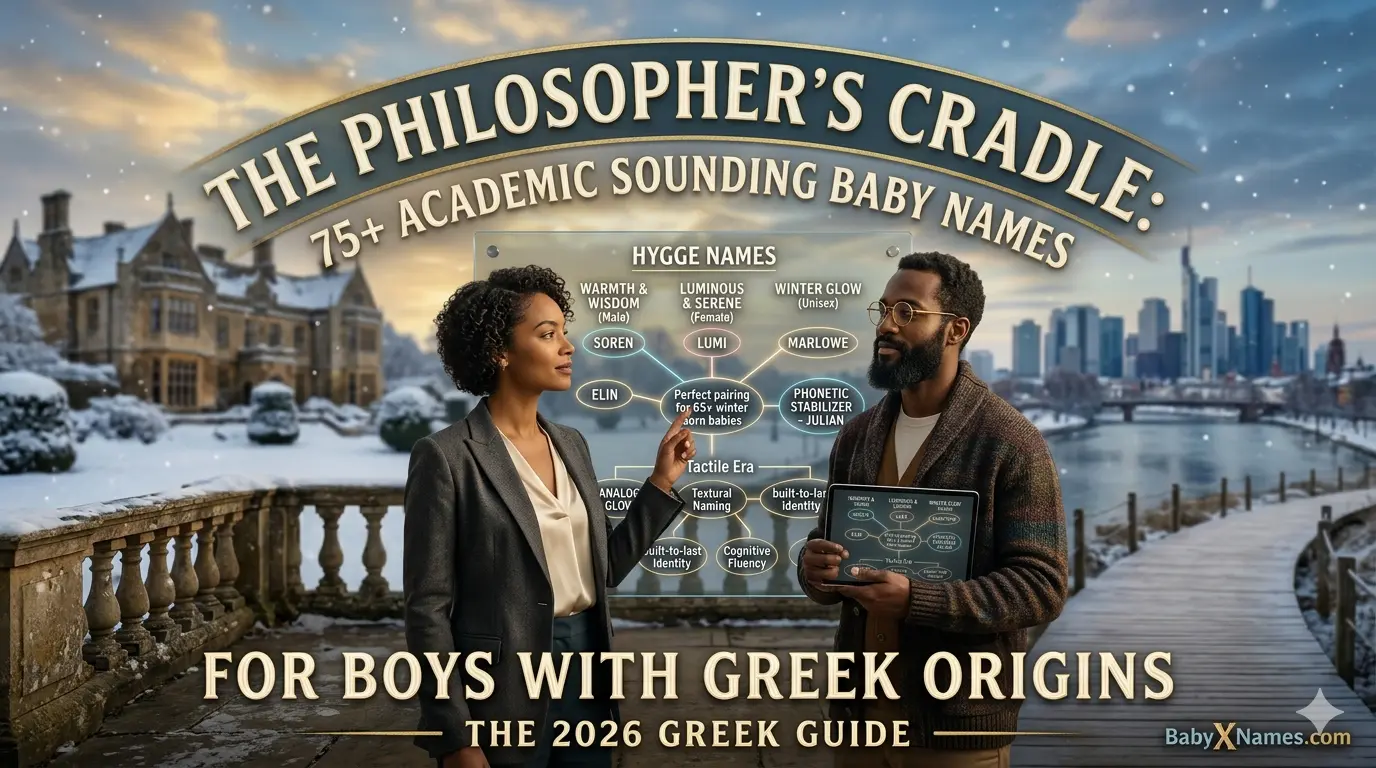
Choosing a name for your son is the first chapter in his lifelong narrative of identity and achievement. For parents in the USA, Canada, the UK, and Australia, the current cultural climate has shifted toward “Intellectual Permanence.” In 2026, we are witnessing a massive resurgence of academic sounding baby names for boys with Greek origins. These names are favored not just for their melodic complexity, but for their direct connection to the foundations of Western philosophy, science, and democratic leadership.
The “naming dilemma” in Tier 1 countries often revolves around finding a balance between a name that is unique and one that carries a sense of “Established Authority.” Greek names provide the perfect solution; they are inherently prestigious and suggest a child who is destined for curiosity, critical thinking, and a life of the mind. This high-authority guide explores the most sophisticated, career-ready Greek names making a significant comeback this year.
Why Greek Roots Define the 2026 “Academic-Chic” Trend
The appeal of Greek onomastics in 2026 lies in its “Ethological Weight.” Unlike trendy, invented names, Greek names have survived thousands of years of social evolution. In an era where AI and digital automation dominate, parents are looking for names that feel “Inherently Human”—names that evoke the imagery of ancient libraries, marble academies, and the pursuit of truth.
Linguistically, Greek names for boys often feature sturdy vowel-consonant balances (like the “os” or “on” endings) that provide a rhythmic, executive cadence. Whether your child eventually navigates the halls of Oxford, the tech hubs of Toronto, or the legal firms of Sydney, these names provide a versatile foundation that works in every high-status professional environment.
The Philosophers & Polymaths: High-Status Greek Names
These names are the “Architects of Thought.” They carry a vibration of wisdom and are perfect for parents who prioritize education and intellectual depth.
1. Theron
- Origin: Greek
- Meaning: “The hunter.”
- Why it’s trending in 2026: Theron offers a sophisticated alternative to the overly common Theo. It sounds academic and established, yet maintains a modern, punchy profile that is skyrocketing in the USA and Canada.
2. Atticus
- Origin: Greek/Latin
- Meaning: “From Attica.”
- Why it’s trending in 2026: While technically a Roman name referencing the Greek region, Atticus is the undisputed champion of the “Literary-Academic” movement. It represents moral integrity and intellectual courage.
3. Lysander
- Origin: Greek
- Meaning: “Liberator” or “Freer of men.”
- Why it’s trending in 2026: Lysander is the quintessential “Oxford Gentleman” name. It is melodic and rare, providing a distinctive identity for a boy in the UK and Australia who values creative leadership.
4. Evander
- Origin: Greek
- Meaning: “Good man.”
- Why it’s trending in 2026: Evander bridges the gap between “Nature-Lite” and “High-Academic.” It sounds like an athlete and a scholar combined, making it a top-tier choice for parents seeking a balanced brand.
The Epic Heroes: Resolute and Authoritative
Names pulled from Greek epic poetry and history suggest a boy who is capable, brave, and strategically minded. They are “Future-Proof” for any professional resume.
5. Cassian
- Origin: Greek/Latin
- Meaning: “Hollow” (referring to the Cassia tree/cinnamon).
- Why it’s trending in 2026: Cassian is the “It-Name” of the decade. It has a rhythmic, three-syllable elegance that sounds both ancient and futuristic, fitting the “Global Executive” aesthetic perfectly.
6. Leander
- Origin: Greek
- Meaning: “Lion-man.”
- Why it’s trending in 2026: Similar to Alexander, but softer and more curated. Leander suggests a “Gentle Strength” that is highly valued by parents in the 2020s.
7. Sebastian
- Origin: Greek
- Meaning: “Venerable” or “Revered.”
- Why it’s trending in 2026: A permanent pillar of the Tier 1 naming charts. Sebastian offers a melodic “Executive Rhythm” that looks incredibly clean on official documents and academic transcripts.
8. Julian
- Origin: Greek/Latin
- Meaning: “Youthful” or “Sky Father.”
- Why it’s trending in 2026: While shared with Latin roots, Julian’s Greek lineage makes it a staple for families seeking a name that implies high “Cognitive Fluency” and social grace.
💡 Pro-Tip for Parents
When selecting academic sounding baby names for boys with Greek origins, use the “Title Test.” Imagine the name on a published journal or a conference lanyard: “Professor [Name] [Surname]” or “Dr. [Name] [Surname]”. If the name carries a natural gravitas in a professional setting, it is a winner for future success.
The “Global Scholar” Shortlist: 2026 Emerging Gems
These names are currently “Under the Radar” but possess the exact phonetic structure required for the next wave of Tier 1 naming trends.
- Linus: (Greek, “Flax”). A scholarly, vintage name with a sophisticated European flair.
- Cyprian: (Greek, “From Cyprus”). A rare, saintly name that sounds like a character from a classic academic novel.
- Phineas: (Greek/Hebrew, “Oracle”). A name that sounds intelligent, quirky, and highly capable.
- Dorian: (Greek, “Gift” or “Of the sea”). The ultimate “Dark Academia” choice, popularized by Oscar Wilde’s literary legacy.
- Elias: (Greek form of Elijah). A crisp, professional name that is a Top 10 favorite in Canada and Australia.
2026 Naming Trend Prediction: The “Soft-Grecian” Era
By late 2026, we predict a move toward “Soft-Grecian” phonetics. Parents are moving away from harsh “K” and “X” sounds in Greek names (like Xander) and toward the softer “L” and “S” sounds found in names like Solon, Silas, and Helios. This trend solves the problem of a name feeling “too aggressive” by adding a layer of shimmering, luminous beauty that represents wisdom rather than warfare. Expect Solon (the name of the Athenian lawgiver) to become a high-status choice for legal and political families.
Frequently Asked Questions (FAQ)
Why are Greek names considered “Academic”?
Greek names are the source of most scientific, philosophical, and medical terminology. This historical association gives the names a subconscious “Halo Effect” of intelligence and high-intent education.
Are these names hard for English speakers to spell?
Most of the names on our shortlist, like Atticus, Theron, and Elias, have “Standardized Orthography.” This means they have one primary spelling that is recognized globally, preventing digital friction in future search results.
How do I pair a Greek first name with a middle name?
To maintain the “Academic Balance,” pair a multi-syllabic Greek name (like Lysander) with a short, punchy English or Latin middle name (like James, Jude, or Grant). This provides a “Rhythmic Break” that sounds professional.
Why is this trend so strong in Australia and the UK?
Both regions have deep ties to classical education and “Commonwealth Tradition.” Greek names provide a sense of heritage and high social status that fits perfectly within these
Final Thoughts: Investing in an Intellectual Identity
Choosing from this list of academic sounding baby names for boys with Greek origins is a strategic investment in your son’s personal brand. By selecting a name that carries the weight of history and the light of ancient wisdom, you are removing future social barriers and replacing them with a foundation of respect.

![Read more about the article Top 500+ Celestial Baby Names And Their Meanings [2026]](https://babyxnames.com/wp-content/uploads/2025/08/Celestial-Baby-Names-300x200.jpg)