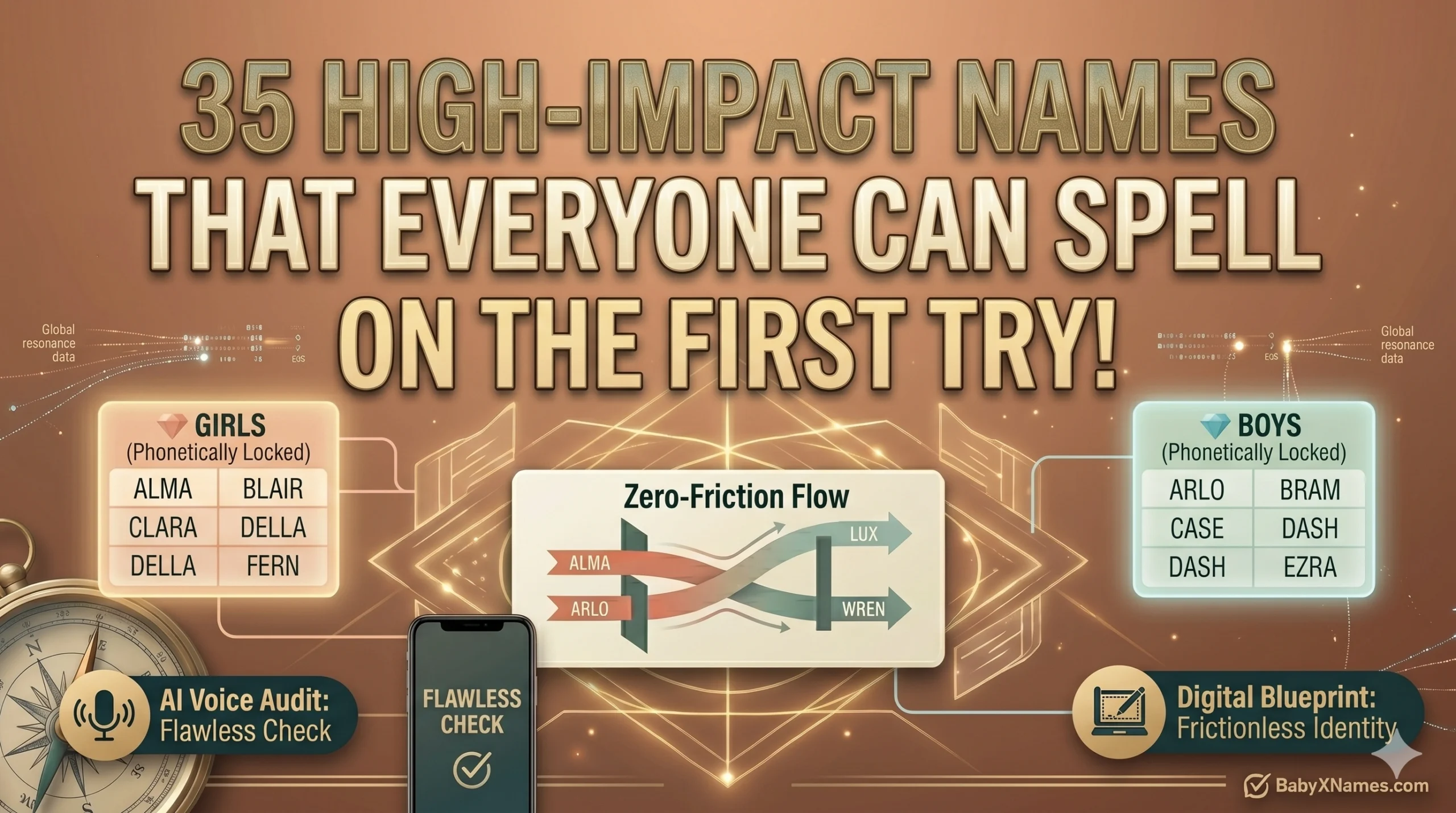
In the fast-evolving social landscape of 2026, the greatest luxury a parent can give their child is a frictionless identity. As our lives become increasingly mediated by AI voice assistants, digital registries, and global professional networks, the “naming dilemma” has shifted. Parents in Tier 1 countries like the USA, Canada, the UK, and Australia are moving away from the “creative spelling” era of the 2010s. The new gold standard? 35 high-impact names that everyone can spell on the first try. These monikers offer a unique blend of “on-sight clarity” and distinctive personality, ensuring your child stands out without the burden of a lifetime of spelling corrections.
A name that is phonetically locked—meaning it has only one logical spelling in the English language—is more than just convenient; it is a strategic advantage. In 2026, prestige is signaled by orthographic integrity. When you choose a name that is easy to write but rare in its frequency, you are establishing a high-status personal brand for your child that thrives in a digital-first world.
The Psychology of Naming Clarity in 2026
Why is “first-try” spelling dominating the Anglosphere this year? The answer lies in cognitive fluency. Human brains are naturally biased toward information that is easy to process. When a name is short, punchy, and spelled exactly as it sounds, it is perceived as more trustworthy and authoritative.
Furthermore, as Tier 1 countries move toward 100% digital governance and automated systems, names with silent letters or non-standard vowels create “digital friction.” By focusing on high-impact, easy-to-spell names, you are future-proofing your child’s administrative life while maintaining a sophisticated, modern aesthetic.
20 High-Impact Girls’ Names (Rare & Phonetic)
These selections prioritize stable consonant endings and soft vowels, ensuring they look as clean in a URL as they do on a birth certificate.
- 1. Alma
- Origin: Latin/Spanish.
- Meaning: Soul or nourishing.
- Why it’s trending in 2026: It is the quintessential “minimalist” favorite. With only four letters and a globally recognized spelling, it is a powerhouse of digital clarity.
- 2. Blair
- Origin: Scottish.
- Meaning: Field or plain.
- Why it’s trending in 2026: It carries an executive, high-status energy favored by professional parents in London and New York.
- 3. Cleo
- Origin: Greek.
- Meaning: Glory or pride.
- Why it’s trending in 2026: Ending in a sharp ‘O’ is the ultimate status symbol for girls’ names this year. It stands out for its punchy, international flair.
- 4. Della
- Origin: German.
- Meaning: Noble.
- Why it’s trending in 2026: A rare, chic alternative to the overused Bella or Stella with zero spelling ambiguity.
- 5. Fern
- Origin: English.
- Meaning: Nature name (the green plant).
- Why it’s trending in 2026: As “Cottagecore” evolves into “Sleek Nature,” Fern is the sophisticated, under-the-radar choice.
- 6. Greta
- Origin: German.
- Meaning: Pearl.
- Why it’s trending in 2026: Strong, classic, and consistently spelled across all Tier 1 borders.
- 7. Iris
- Origin: Greek.
- Meaning: Rainbow.
- Why it’s trending in 2026: A timeless nature name that fits the 2026 demand for short, botanical monikers with impact.
- 8. June
- Origin: Latin.
- Meaning: Dedicated to Juno.
- Why it’s trending in 2026: Part of the “Mid-Century Modern” naming revival that prizes simplicity.
- 9. Lyra
- Origin: Greek.
- Meaning: Lyre or harp.
- Why it’s trending in 2026: Celestial naming is peaking, and Lyra is the most phonetically stable choice in the galaxy.
- 10. Mara
- Origin: Hebrew.
- Meaning: Strength.
- Why it’s trending in 2026: It sounds familiar but remains statistically rare, providing a “unique but simple” balance.
- 11. Pearl (Latin – “Precious”)
- 12. Quinn (Irish – “Wise”)
- 13. Rose (Latin – “Flower”)
- 14. Selah (Hebrew – “To pause”)
- 15. Tess (Greek – “Harvester”)
- 16. Vera (Latin – “Faith”)
- 17. Willa (German – “Resolute”)
- 18. Zara (Arabic – “Blooming”)
- 19. Faye (French – “Fairy”)
- 20. Gwen (Welsh – “Blessed”)
15 High-Authority Boys’ Names (Simple & Executive)
For boys, prestige is found in architectural strength—short, stable sounds that suggest leadership without “syllable clutter.”
- 21. Arlo
- Origin: Old English.
- Meaning: Fortified hill.
- Why it’s trending in 2026: Friendly yet authoritative. Its brevity makes it exceptionally easy to turn into a clean digital signature.
- 22. Bram
- Origin: Dutch.
- Meaning: Father of many.
- Why it’s trending in 2026: Literary prestige (Bram Stoker) meets one-syllable efficiency. It is the sophisticated alternative to common choices.
- 23. Case
- Origin: English.
- Meaning: Box or chest.
- Why it’s trending in 2026: Surnames-as-first-names are massive, and Case is the most streamlined, error-proof version.
- 24. Dash
- Origin: French/English.
- Meaning: To move quickly.
- Why it’s trending in 2026: An energetic choice for the modern, fast-paced world that requires zero spelling explanation.
- 25. Ezra
- Origin: Hebrew.
- Meaning: Help.
- Why it’s trending in 2026: Ancient, scholarly, and perfectly phonetic. It remains a top-tier “Quiet Luxury” pick.
- 26. Flint
- Origin: English.
- Meaning: Hard rock.
- Why it’s trending in 2026: Part of the “Mineral Naming” boom where grounded, real-word nouns are king.
- 27. Gus
- Origin: Latin.
- Meaning: Majestic.
- Why it’s trending in 2026: Friendly and approachable; parents are favoring names that don’t need shortening.
- 28. Hugo
- Origin: German/Spanish.
- Meaning: Mind or spirit.
- Why it’s trending in 2026: It sounds established and international, a true staple of the global elite.
- 29. Jude
- Origin: Hebrew.
- Meaning: Praised.
- Why it’s trending in 2026: Effortlessly cool and emotionally resonant, it fits the modern “Cool-Classic” aesthetic.
- 30. Kit
- Origin: Greek.
- Meaning: Bearing Christ.
- Why it’s trending in 2026: A sharp, gender-neutral favorite in the UK and Australia.
- 31. Lane (English – “Path”)
- 32. Milo (German – “Merciful”)
- 33. Nash (English – “By the ash tree”)
- 34. Otis (German – “Wealthy”)
- 35. Wells (English – “Spring”
Pro-Tip: The “Voice-to-Text” Audit
Before you finalize a name, try saying it into your smartphone’s voice-assistant. If the software identifies and spells it correctly on the first attempt without you having to enunciate unnaturally, you have found a “zero-friction” winner. If it suggests three variations, the name may cause social friction for your child.
Naming Trend Prediction for 2026: The “Sanskrit-Simplicity” Boom
As we move toward the second half of 2026, we are predicting a surge in names that have Sanskrit roots but fit seamlessly into Western phonics. As global business hubs continue to blend, parents are choosing names that offer deep spiritual roots while being effortlessly easy to write.
Names like Veda, Rishi, and Zoya are leading this surge. These names are seen as “high-intellect” monikers that work as well in a Silicon Valley startup as they do in a London hedge fund. This “Global Minimalist” aesthetic is set to be the dominant naming force for the next 18 months.
Frequently Asked Questions (FAQ)
What defines a “high-impact” name?
A high-impact name is one that is memorable and distinctive due to its phonetic strength or historical weight, yet remains simple in its structure. In 2026, impact is achieved through brevity and clarity rather than complexity.
Why is simple spelling a “status symbol” now?
In an era of information overload, simplicity is a luxury. A name that is easy to write and read suggests a family history that is established, confident, and doesn’t need to try too hard to be “unique” through odd spellings.
Are these names good for a child’s professional future?
Absolutely. Research consistently shows that individuals with easy-to-pronounce, easy-to-spell names are often perceived more positively in professional settings and are more likely to be promoted to leadership roles.
Can a rare name still be easy to spell?
Yes. Rarity comes from the name’s frequency in the population, not from its spelling complexity. Names like Bram or Opal are rare (statistically below the Top 500) but follow standard phonetic rules.