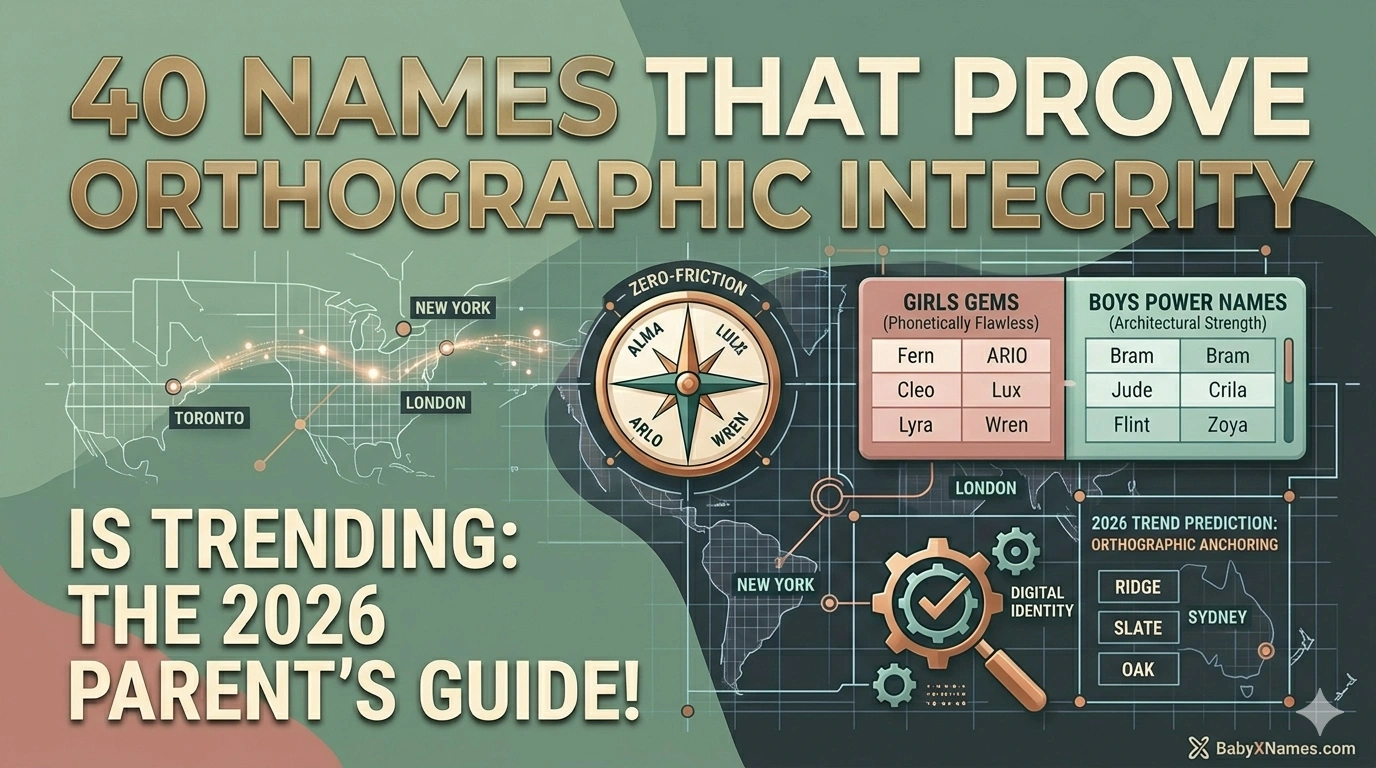
For years, the nursery was dominated by a wave of “creative orthography”—an era where parents sought uniqueness by replacing ‘I’s with ‘Y’s and adding silent, decorative consonants. However, as we move through 2026, a sophisticated counter-movement has taken hold across Tier 1 countries like the USA, Canada, UK, and Australia. Modern parents are rediscovering the power of linguistic purity. Choosing one of these 40 names that prove orthographic integrity is trending is no longer just a traditional choice; it is a strategic move toward “Clean Onomastics” and frictionless digital identities.
The current “naming dilemma” is defined by a desire for a name to be both rare and “correct.” Orthographic integrity refers to names that are spelled exactly according to their historical or phonetic roots, without modern embellishments. In a world of automated systems and global networking, a name that is spelled correctly on the first try is a significant social asset. This guide explores the names leading the charge toward a more authentic, phonetically stable future for the next generation.
Why Orthographic Integrity is the New Status Symbol
In 2026, prestige is signaled by restraint. Much like the “Quiet Luxury” movement in fashion, the naming world has moved away from “loud” spellings. A name with orthographic integrity suggests an established, confident background. It indicates that the parents didn’t feel the need to “decorate” a name to make it special—the name’s history and sound carry enough weight on their own.
Furthermore, as our interactions become increasingly digital, orthographic integrity reduces “clerical friction.” From airline bookings to school enrollment forms, a name that follows standard phonetic paths is a functional gift to your child. It ensures they spend less time correcting others and more time building their personal brand.
20 Girls’ Names Leading the Integrity Movement
These names prioritize historical accuracy and phonetic clarity, proving that simplicity is the ultimate sophistication in 2026.
- 1. Alma
- Origin: Latin.
- Meaning: Soul or nourishing.
- Why it’s trending in 2026: It is the quintessential “Integrity Name.” It’s short, soulful, and hasn’t been subjected to “creative” variations.
- 2. Blair
- Origin: Scottish.
- Meaning: Field or plain.
- Why it’s trending in 2026: Its sharp, preppy energy fits the modern professional aesthetic while remaining phonetically locked.
- 3. Clara
- Origin: Latin.
- Meaning: Bright and clear.
- Why it’s trending in 2026: Parents are ditching the clunky Clarence for this sleek version that embodies its own meaning.
- 4. Della
- Origin: German.
- Meaning: Noble.
- Why it’s trending in 2026: It offers a rare, chic alternative to Bella with zero spelling ambiguity.
- 5. Edith
- Origin: Old English.
- Meaning: Prosperous in war.
- Why it’s trending in 2026: Part of the “Grandmillennial” revival, focusing on names with deep, unedited roots.
- 6. Flora
- Origin: Latin.
- Meaning: Flower.
- Why it’s trending in 2026: Nature names are becoming more sculptural and less “flowery.” Flora is the stable botanical choice.
- 7. Greta
- Origin: German.
- Meaning: Pearl.
- Why it’s trending in 2026: Strong, classic, and consistently spelled across all Tier 1 borders.
- 8. Iris
- Origin: Greek.
- Meaning: Rainbow.
- Why it’s trending in 2026: A timeless classic that satisfies the 2026 demand for short, botanical names.
- 9. June
- Origin: Latin.
- Meaning: Dedicated to Juno.
- Why it’s trending in 2026: Seasonal names are shifting back to their most basic, elegant forms.
- 10. Lyra
- Origin: Greek.
- Meaning: Lyre or harp.
- Why it’s trending in 2026: Celestial names are peaking, and Lyra is the most phonetically stable astronomical pick.
- 11. Mara (Hebrew – “Strength”)
- 12. Nell (English – “Bright light”)
- 13. Opal (Sanskrit – “Gemstone”)
- 14. Pearl (Latin – “Precious”)
- 15. Quinn (Irish – “Wise”)
- 16. Rose (Latin – “Flower”)
- 17. Selah (Hebrew – “To pause”)
- 18. Tess (Greek – “Harvester”)
- 19. Vera (Latin – “Faith”)
- 20. Willa (German – “Resolute”)
20 Boys’ Names with Strong Phonetic Roots
For boys, integrity is found in architectural strength—short, stable names that require no translation.
- 21. Arlo
- Origin: Old English.
- Meaning: Fortified hill.
- Why it’s trending in 2026: It is the “global executive” favorite, working perfectly in San Francisco, London, and Sydney.
- 22. Bram
- Origin: Dutch/Hebrew.
- Meaning: Father of many.
- Why it’s trending in 2026: Literary prestige meets one-syllable simplicity.
- 23. Case
- Origin: English.
- Meaning: Box or chest.
- Why it’s trending in 2026: Surnames-as-first-names are peaking, and Case is the most streamlined, error-proof version.
- 24. Dash
- Origin: French/English.
- Meaning: To move quickly.
- Why it’s trending in 2026: An action-oriented name for the high-energy lifestyles of the late 2020s.
- 25. Ezra
- Origin: Hebrew.
- Meaning: Help.
- Why it’s trending in 2026: Ancient, scholarly, and perfectly phonetic.
- 26. Flint
- Origin: English.
- Meaning: Hard rock.
- Why it’s trending in 2026: Real-word nouns are king because their spelling is already dictated by the dictionary.
- 27. Gus
- Origin: Latin.
- Meaning: Majestic.
- Why it’s trending in 2026: Friendly and approachable; parents are favoring names that don’t need shortening.
- 28. Hugo
- Origin: German/Spanish.
- Meaning: Mind or spirit.
- Why it’s trending in 2026: It sounds established, international, and is recognized globally.
- 29. Jude
- Origin: Hebrew.
- Meaning: Praised.
- Why it’s trending in 2026: Effortlessly cool and emotionally resonant.
- 30. Kit
- Origin: Greek.
- Meaning: Bearing Christ.
- Why it’s trending in 2026: A sharp, gender-neutral favorite in the UK and Australia.
- 31. Lane (English – “Path”)
- 32. Milo (German – “Merciful”)
- 33. Nash (English – “By the ash tree”)
- 34. Otis (German – “Wealthy”)
- 35. Piers (Greek – “Rock”)
- 36. Reid (English – “Red-haired”)
- 37. Seth (Hebrew – “Appointed”)
- 38. Tate (Norse – “Cheerful”)
- 39. Vance (English – “Marshland”)
- 40. Wells (English – “Spring”)
Pro-Tip: The “Voice-to-Text” Audit
Before you finalize a name, try saying it into your phone’s voice-to-text feature. If the AI spells it correctly on the first try without you having to enunciate like a robot, the name has strong orthographic integrity. In 2026, a name that AI understands is a name that the world understands.
Naming Trend Prediction for 2026: The “Orthographic Anchoring” Surge
As we look toward the second half of 2026, we predict the rise of “Orthographic Anchoring.” This is a movement where parents choose names that are existing English words (like Ridge, Slate, or Wren) specifically because they cannot be misspelled.
By anchoring a child’s identity to a known word, parents are ensuring “Zero-Friction” social interactions. This trend is especially prevalent in digital-heavy regions like Silicon Valley, London’s tech city, and the creative hubs of Toronto and Melbourne.
Frequently Asked Questions (FAQ)
What is “Orthographic Integrity”?
Orthographic integrity is the practice of using the most standard, historical, or dictionary-correct spelling of a name. It rejects “creative” or intentional misspellings (like Jaxson for Jackson).
Why are names like “Alma” and “Arlo” trending in 2026?
These names are short, globally recognized, and follow a simple vowel-consonant structure. They embody the “Clean Onomastics” movement which prioritizes clarity over ornamentation.
Can a rare name still have orthographic integrity?
Absolutely. Names like Bram or Opal are rare (statistically below the Top 500) but follow standard phonetic rules, making them both unique and easy to spell.
How does orthographic integrity help a child’s professional future?
A name that is easy to read and write reduces errors in professional communications. It projects a sense of competence and heritage, which can be an advantage in competitive Tier 1
![Read more about the article Top 300+ Scottish Baby Boy Names with Meanings [2026]](https://babyxnames.com/wp-content/uploads/2025/08/Scottish-Baby-Boy-Names-300x200.jpg)