Finding a baby name that stands out in a crowded classroom but doesn’t require a spelling tutorial at every doctor’s visit is the ultimate goal for the modern parent. In 2026, the “naming dilemma” has shifted away from over-complicated, creative spellings toward a movement we call “Clean Distinction.” Parents in Tier 1 countries like the USA, Canada, UK, and Australia are searching for 55 names that are easy to spell but rarely heard to provide their children with a frictionless yet memorable identity. Choosing a name with phonetic clarity ensures your child’s digital footprint is clean, while its rarity guarantees they remain one-of-a-kind.
The current social climate prizes “Quiet Luxury” in naming—monikers that carry historical weight or natural beauty without the need for silent letters or decorative vowels. By focusing on names that are statistically rare but orthographically intuitive, you are gifting your child a name that is as practical as it is prestigious.
The Power of Phonetic Clarity in a Digital-First World
In an era of AI voice assistants and automated registries, a name that is spelled exactly as it sounds is a massive administrative advantage. A name like Arlo or Fern is virtually “error-proof.” It avoids the frustration of a lifetime spent correcting clerical errors or clarifying vowels on legal documents.
However, “easy to spell” often mistakenly gets equated with “common.” The names in this guide prove that you can achieve onomastic individuality without sacrificing simplicity. These are names that follow standard English phonetic paths but haven’t yet reached the “Top 100” saturation point.
25 Distinctive Girls’ Names (Rare & Intuitive)
These names prioritize soft vowels and stable consonant anchors, making them a dream for digital registries and social introductions.
- 1. Alma
- Origin: Latin.
- Meaning: Soul or nourishing.
- Why it’s trending in 2026: It captures the “Vintage Minimalist” aesthetic currently sweeping through London and New York.
- 2. Blair
- Origin: Scottish.
- Meaning: Field or plain.
- Why it’s trending in 2026: It exudes a preppy, executive energy that feels powerful and modern.
- 3. Cleo
- Origin: Greek.
- Meaning: Glory or pride.
- Why it’s trending in 2026: Short “O” ending names are the leading trend for girls this year.
- 4. Della
- Origin: German.
- Meaning: Noble.
- Why it’s trending in 2026: A chic, under-the-radar alternative to the overused Bella.
- 5. Elara
- Origin: Greek Mythology.
- Meaning: Shining or bright.
- Why it’s trending in 2026: Celestial names are peaking, and Elara is the most phonetically stable moon name.
- 6. Fern
- Origin: English.
- Meaning: Nature name (the green plant).
- Why it’s trending in 2026: As “Cottagecore” evolves into “Sleek Nature,” Fern is the sophisticated choice.
- 7. Greta
- Origin: German.
- Meaning: Pearl.
- Why it’s trending in 2026: Strong, classic, and impossible to misspell across the Anglosphere.
- 8. Iris
- Origin: Greek.
- Meaning: Rainbow.
- Why it’s trending in 2026: It satisfies the 2026 demand for botanical names that are short and punchy.
- 9. June
- Origin: Latin.
- Meaning: Young; dedicated to Juno.
- Why it’s trending in 2026: A part of the “Mid-Century Modern” naming revival.
- 10. Lyra
- Origin: Greek.
- Meaning: Lyre or harp.
- Why it’s trending in 2026: Musical and astronomical, it is a high-status choice for 2026.
- 11. Mara (Hebrew – “Strength”)
- 12. Nell (English – “Bright light”)
- 13. Opal (Sanskrit – “Gemstone”)
- 14. Pearl (Latin – “Precious”)
- 15. Quinn (Irish – “Wise”)
- 16. Rose (Latin – “Flower”)
- 17. Selah (Hebrew – “To pause”)
- 18. Tess (Greek – “Harvester”)
- 19. Vera (Latin – “Faith”)
- 20. Willa (German – “Resolute”)
- 21. Zara (Arabic – “Blooming”)
- 22. Faye (French – “Fairy”)
- 23. Gwen (Welsh – “Blessed”)
- 24. Hope (English – “Virtue”)
- 25. Lark (English – “Songbird”)
30 High-Status Boys’ Names (Simple & Standout)
For boys, we are seeing a move toward architectural strength—names that suggest leadership without “syllable clutter.”
- 26. Arlo
- Origin: Old English.
- Meaning: Fortified hill.
- Why it’s trending in 2026: It is a “global executive” favorite, working perfectly in San Francisco, London, and Sydney.
- 27. Bram
- Origin: Dutch/Hebrew.
- Meaning: Father of many.
- Why it’s trending in 2026: Literary prestige meets one-syllable simplicity.
- 28. Case
- Origin: English.
- Meaning: Box or chest.
- Why it’s trending in 2026: Surnames-as-first-names are peaking, and Case is the most streamlined version.
- 29. Dash
- Origin: French/English.
- Meaning: To move quickly.
- Why it’s trending in 2026: An action-oriented name for the high-energy lifestyles of 2026.
- 30. Ezra
- Origin: Hebrew.
- Meaning: Help.
- Why it’s trending in 2026: Scholarly and perfectly phonetic, it remains a favorite for the “Quiet Luxury” set.
- 31. Flint
- Origin: English.
- Meaning: Hard rock.
- Why it’s trending in 2026: Grounded nouns are king in 2026. If it’s in the dictionary, it’s easy to spell.
- 32. Gus
- Origin: Latin.
- Meaning: Majestic.
- Why it’s trending in 2026: Friendly and approachable; parents are favoring names that don’t need shortening.
- 33. Hugo
- Origin: German/Spanish.
- Meaning: Mind or spirit.
- Why it’s trending in 2026: A global “power name” that sounds established and international.
- 34. Jude
- Origin: Hebrew.
- Meaning: Praised.
- Why it’s trending in 2026: Effortlessly cool and emotionally resonant.
- 35. Kit
- Origin: Greek.
- Meaning: Bearing Christ.
- Why it’s trending in 2026: A sharp, gender-neutral favorite in the UK and Australia.
- 36. Lane (English – “Path”)
- 37. Milo (German – “Merciful”)
- 38. Nash (English – “By the ash tree”)
- 39. Otis (German – “Wealthy”)
- 40. Piers (Greek – “Rock”)
- 41. Reid (English – “Red-haired”)
- 42. Seth (Hebrew – “Appointed”)
- 43. Tate (Norse – “Cheerful”)
- 44. Vance (English – “Marshland”)
- 45. Wells (English – “Spring”)
- 46. Zane (Hebrew – “God’s gift”)
- 47. Cole (English – “Victory”)
- 48. Finn (Irish – “Fair”)
- 49. Grant (French – “Great”)
- 50. Hart (English – “Stag”)
- 51. Ivan (Slavic – “God is gracious”)
- 52. Jett (English – “Gem/Aircraft”)
- 53. Knox (Scottish – “Hill”)
- 54. Luke (Greek – “Light”)
- 55. Nico (Greek – “Victory”)
Pro-Tip: The “Voice-Assistant” AuditBefore finalizing your choice, try shouting the name into your phone’s voice-to-text feature. If the AI spells it correctly on the first attempt without you having to enunciate like a robot, you have found a “zero-friction” winner. This is a vital test for names in the 2026 digital ecosystem.
Naming Trend Prediction for 2026: The “Mineral” Surge
We predict that by the end of 2026, “Mineral and Stone” names will become the new status symbol for the sophisticated parent. As the world becomes increasingly virtual, there is a subconscious psychological pull toward names that feel “solid” and “grounded.”
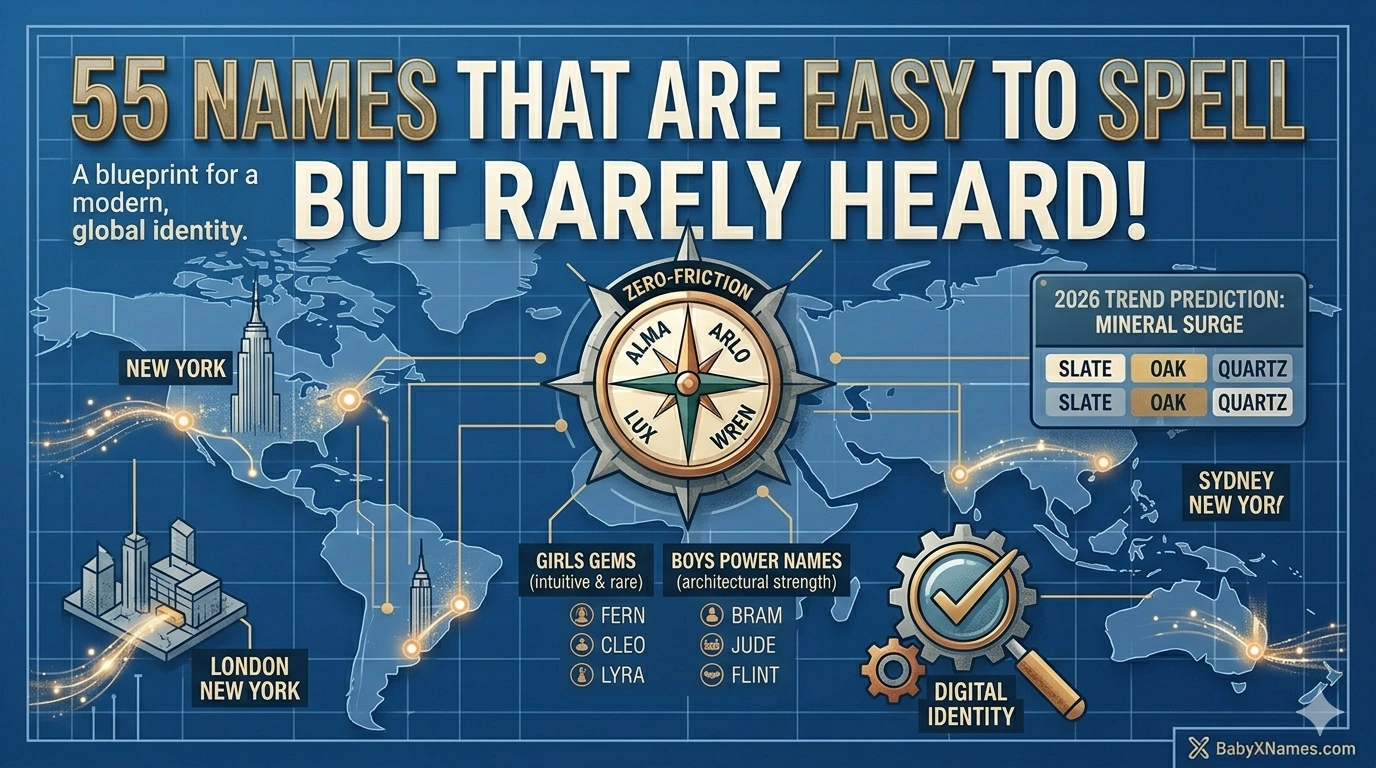
Names like Slate, Pike, Hart, and Quartz are expected to rise. These names are perfectly optimized; they are short, easy to spell, and provide a level of rugged individuality that traditional names often lack.
Frequently Asked Questions (FAQ)
What defines an “easy to spell” baby name?
An easy-to-spell name follow standard English phonetic rules, meaning it is written exactly as it sounds. These names avoid ambiguous vowel combinations (like “ae” vs “ea”) and silent letters.
Why is simple spelling a “status symbol” in 2026?
In a world of information overload, simplicity is a luxury. A name that is easy to read and write suggests a family history that is established, confident, and doesn’t need to try too hard to be “unique” through odd spellings.
Can a rare name still be easy to spell?
Absolutely. Rarity comes from the name’s frequency in the population, not from its spelling complexity. Names like Bram or Opal are rare but follow standard phonetic rules.
Why focus on Tier 1 countries like USA and UK?
Tier 1 countries share highly integrated digital systems and professional networks. A name that works seamlessly in New York will likely have the same “zero-friction” effect in London or Sydney.