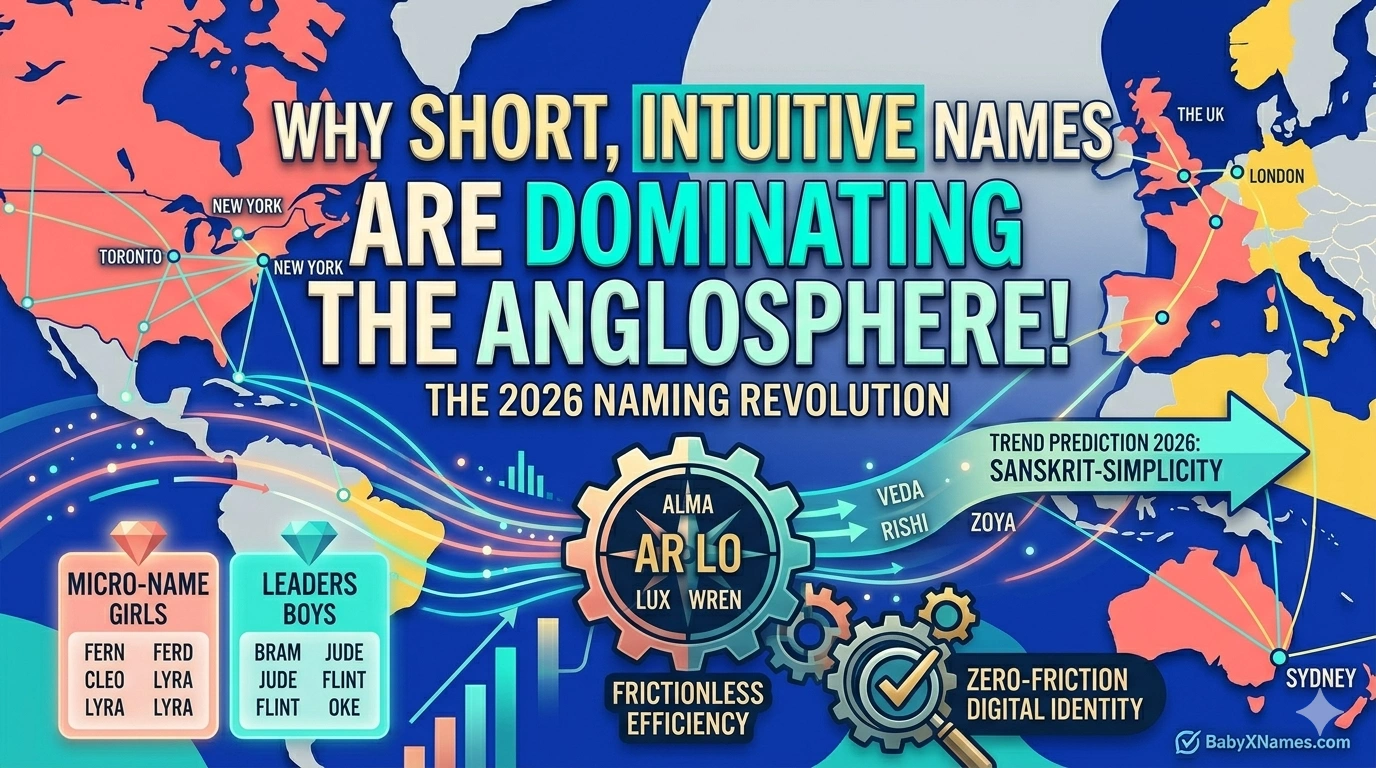
In the bustling digital and social landscapes of 2026, a quiet revolution is happening in the nursery. Gone are the days of the four-syllable, ornamentally spelled monikers that required a pronunciation guide and a significant amount of “digital real estate.” Today, parents in the USA, Canada, UK, and Australia are pivoting toward “Micro-Names.” If you’ve noticed a surge in toddlers named Arlo, Finn, or Cleo, you are witnessing a major cultural shift. Understanding why short, intuitive names are dominating the Anglosphere is essential for any modern parent looking to solve the “naming dilemma” while providing their child with a frictionless, high-status identity.
The shift toward brevity and phonetic clarity isn’t just a matter of taste; it’s a practical response to a fast-paced, digital-first world. A short name acts as a sleek, efficient brand. In an era where attention spans are measured in seconds and character limits are omnipresent, a name that can be shouted across a playground—and spelled correctly on a Starbucks cup—carries its own form of “quiet luxury.”
The “Frictionless” Factor: Why Brevity Wins in 2026
The primary reason why short, intuitive names are dominating the Anglosphere is the desire for “Zero-Friction” living. Tier 1 countries share a high reliance on automated systems, from airline check-ins to school registries. A name like Lux or Reid is virtually “error-proof.” It bypasses the clerical errors and constant spelling clarifications that plague names with creative orthography (like Jaxon vs. Jaxson vs. Jaxxon).
Furthermore, there is a psychological component known as “cognitive fluency.” Human brains are naturally biased toward information that is easy to process. When a name is short and spelled exactly as it sounds, it is perceived as more trustworthy, approachable, and prestigious. In the Anglosphere’s competitive professional environments, this early-onset clarity is being viewed as a significant social advantage.
Top Short, Intuitive Names Leading the 2026 Charts
To help you navigate this high-authority trend, we have curated the most impactful “Micro-Names” currently rising in popularity across the USA and its peer nations.
Striking “Micro-Names” for Girls
- 1. Alma
- Origin: Latin/Spanish.
- Meaning: Soul or nourishing.
- Why it’s trending in 2026: It hits the “Vintage Minimalist” trend perfectly. It is short, carries deep history, and has a globally consistent spelling.
- 2. Cleo
- Origin: Greek.
- Meaning: Glory.
- Why it’s trending in 2026: Ending in a sharp ‘O’ is the ultimate status symbol for girls’ names this year. It’s punchy and impossible to misspell.
- 3. Fern
- Origin: English.
- Meaning: A green, shade-loving plant.
- Why it’s trending in 2026: As “Cottagecore” evolves into “Sleek Nature,” Fern has replaced more complex botanical names like Juniper.
- 4. Lyra
- Origin: Greek.
- Meaning: Lyre (the musical instrument).
- Why it’s trending in 2026: Celestial naming is massive, and Lyra is the most phonetically stable choice in the astronomical category.
- 5. Tess
- Origin: Greek.
- Meaning: Harvester.
- Why it’s trending in 2026: Parents are ditching nicknames in favor of “complete” short names that don’t need shortening.
Powerful “Micro-Names” for Boys
- 6. Arlo
- Origin: Old English/Spanish.
- Meaning: Fortified hill.
- Why it’s trending in 2026: It is the “Global Executive” favorite. It works in Sydney as well as it does in San Francisco.
- 7. Bram
- Origin: Dutch/Hebrew.
- Meaning: Father of many.
- Why it’s trending in 2026: Literary prestige (Bram Stoker) without the length of Abraham. It’s sophisticated and grounded.
- 8. Flint
- Origin: English.
- Meaning: A hard quartz rock.
- Why it’s trending in 2026: Part of the “Mineral Surge.” Real-word nouns are favored because their spelling is already dictated by the dictionary.
- 9. Hugo
- Origin: German/Spanish.
- Meaning: Mind or spirit.
- Why it’s trending in 2026: It sounds established and international. It’s a “power name” that remains easy to document.
- 10. Jude
- Origin: Hebrew.
- Meaning: Praised.
- Why it’s trending in 2026: Effortlessly rhythmic and emotionally resonant, it fits the modern “Cool-Classic” aesthetic.
Pro-Tip: The “Digital Signature” Audit
Before finalizing a name, type it out on your phone. See how it looks in an email address format (e.g., jane.doe@company.com). Short names often look cleaner and more professional in digital headers. If the name is so short it looks like an acronym, consider adding a slightly longer middle name for balance.
Why the UK, USA, Canada, and Australia are Syncing
Social media and global digital platforms have created a “Transatlantic Naming Culture.” A trend in London now hits Los Angeles and Melbourne within weeks. The reason why short, intuitive names are dominating the Anglosphere collectively is that these Tier 1 nations share a common “Efficiency Value.”
We see a move away from names that signal “trying too hard.” A short name like Sloan or Wells signals that the child belongs to an established, confident background. In the Anglosphere, where social mobility and personal branding are intertwined, a name that is easy to remember is a name that is easy to promote.
Naming Trend Prediction for 2026: The “Sanskrit-Simplicity” Boom
As we move toward the latter half of 2026, we predict a surge in names with Sanskrit roots that fit the “short and intuitive” criteria. Names like Veda, Rishi, and Zoya are gaining massive traction in Tier 1 countries.
These names offer a perfect “Individuality vs. Friction” balance. They provide a unique cultural depth while following simple phonetic paths that Western speakers can navigate without error. This “Global Minimalist” aesthetic is set to be the dominant naming force for the next 18 months.
Frequently Asked Questions (FAQ)
What defines a “short and intuitive” name?
A short name typically has one or two syllables and fewer than six letters. An “intuitive” name follows standard English phonetic rules, meaning it is spelled exactly as it sounds.
Does a short name lack “substance”?
Absolutely not. Historically, some of the most powerful names are short (e.g., John, Ruth, Mark, Rose). In 2026, brevity is seen as a sign of confidence and modern sophistication.
Are these names good for SEO and social media?
Yes! Short names are easier to turn into social media handles and are more memorable for search queries. This provides your child with a cleaner digital footprint as they grow.
Why is the Anglosphere moving away from “Creative Spellings”?
The “creative spelling” era (e.g., Kaytlynne) is seen as a logistical burden in the 2020s. Parents now prioritize their child’s ease of life over the desire for an “original” letter combination that causes confusion.